Quick Answer
Compare each platform’s current custody, key-export and recovery documentation directly. The published wallet documentation describes user-controlled, exportable private keys. Agent execution is separately documented as using server-side managed wallets; review that model before enabling automation. Secure your sign-in account and any exported backup. Self-custody does not eliminate interface, account, smart-contract or market risk.
Compare each platform’s current custody, key-export and recovery documentation directly. The published wallet documentation describes user-controlled, exportable private keys. Agent execution is separately documented as using server-side managed wallets; review that model before enabling automation. Secure your sign-in account and any exported backup. Self-custody does not eliminate interface, account, smart-contract or market risk.
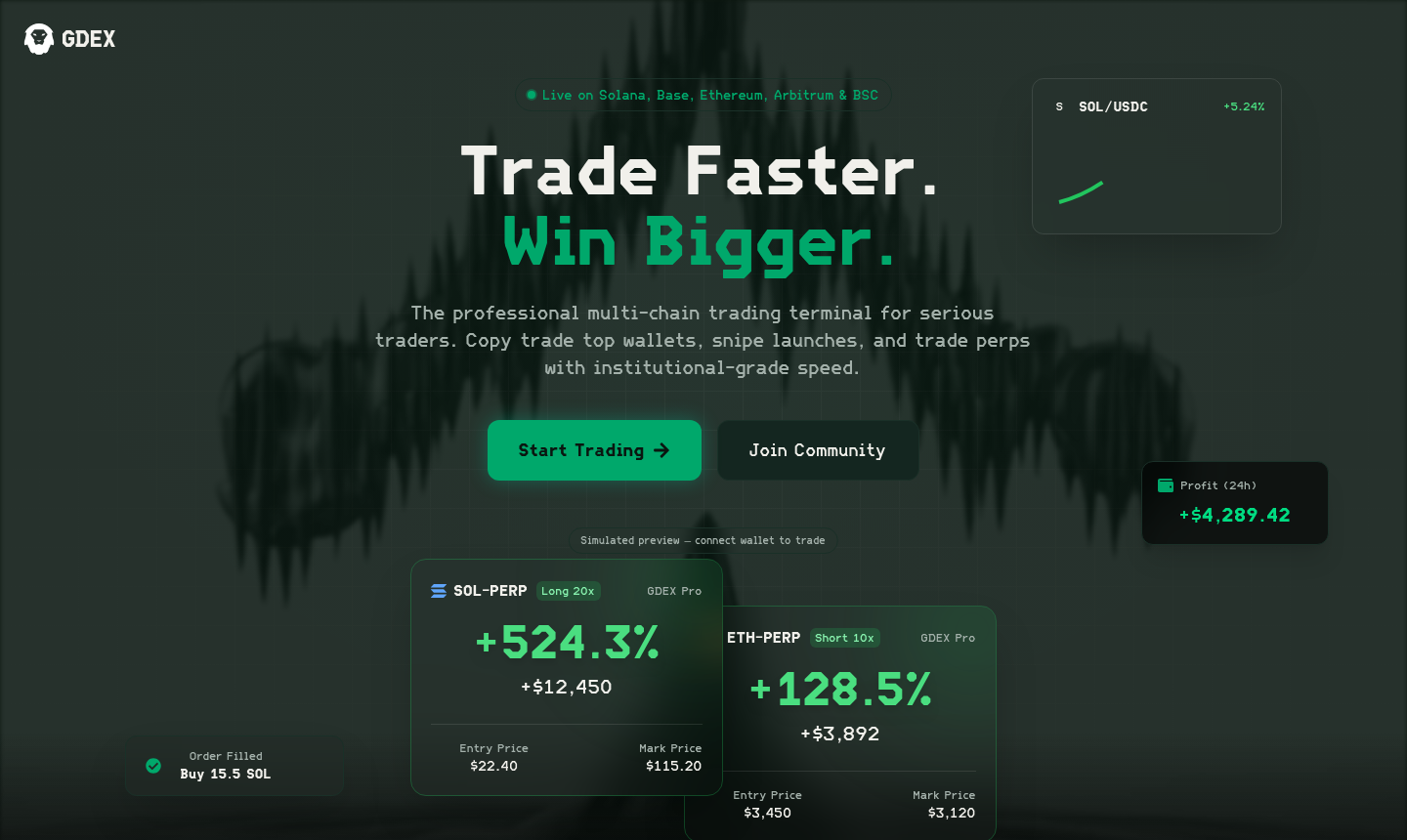
GDEX Pro, built by GemachDAO, is a self-custody, multi-chain trading terminal and swap aggregator that removes that split. One account, opened by signing in with Google or Apple, gives you trading access across Solana, Ethereum, Base, BNB, Arbitrum, Optimism, Sui, Sonic, and Berachain — the nine highlighted networks total. It is not a decentralized exchange and not a centralized exchange; it is a terminal that routes your swaps and aggregates liquidity while you keep control of your keys. Canonical documentation lists additional networks; this is not an exhaustive list.
This matters for anyone who trades across ecosystems, not just Solana memecoins. New token launches, liquidity, and narratives rotate between chains constantly. A terminal that only covers one chain forces you to either miss opportunities elsewhere or manage a separate stack of wallets and apps for each network you touch.
Below is a direct comparison of chain coverage, custody model, on-ramp, and fees across GDEX Pro and the trading tools most often searched alongside it.
How GDEX Pro Compares
GDEX Pro vs Solana-focused trading terminals: chain coverage, custody, on-ramp, and fees
| Spec | GDEX Pro | BullX / Photon / Axiom | Trojan |
|---|---|---|---|
| Chains supported | 9 (Solana, Ethereum, Base, BNB, Arbitrum, Optimism, Sui, Sonic, Berachain) | Verify current vendor documentation | Verify current vendor documentation |
| Access method | Browser, sign in with Google or Apple, no app download | Verify current vendor documentation | Verify current vendor documentation |
| Custody model | Self-custody via Web3Auth threshold cryptography, no seed phrase, exportable private key | Verify current vendor documentation | Verify current vendor documentation |
| Fiat on-ramp | Apple Pay, $50 minimum, signup-to-trade without KYC, ~2-3% fee No KYC is required for GDEX signup-to-trade. Third-party on-ramp providers may require identity verification and apply eligibility restrictions. | Verify current vendor documentation | Verify current vendor documentation |
| Swap fee | ~1% | Verify current vendor documentation | Verify current vendor documentation |
| Perpetuals | Yes, via HyperLiquid | Verify current vendor documentation | Verify current vendor documentation |
| AI copy-trading | up to 6 AI agent wallets with Conservative, Balanced, Aggressive presets | Verify current vendor documentation | Verify current vendor documentation |
Step-by-Step Guide
Sign in with Google or Apple
Create your GDEX Pro account using a Google or Apple login. There is no seed phrase to write down at setup, since custody is handled through Web3Auth threshold cryptography.
Fund your account
Deposit crypto directly, or use the Apple Pay on-ramp to buy in with a $50 minimum, signup-to-trade without KYC, at roughly a 2-3% on-ramp fee. No KYC is required for GDEX signup-to-trade. Third-party on-ramp providers may require identity verification and apply eligibility restrictions.
Select a chain and trade
Choose from the 9 supported chains — Solana, Ethereum, Base, BNB, Arbitrum, Optimism, Sui, Sonic, or Berachain — and execute swaps at roughly a 1% fee, or open perpetuals through the built-in HyperLiquid integration.

Why chain coverage decides which terminal you need
GDEX supports nine highlighted chains: Solana, Ethereum, Base, BNB, Arbitrum, Optimism, Sui, Sonic, Berachain. Verify each alternative’s current chain and feature coverage directly; no ranking is established here.
GDEX Pro's 9-chain coverage means the same account, the same login, and the same custody setup carries over regardless of which network the opportunity is on. That reduces the number of separate wallets and recovery phrases you need to track, which is itself a security benefit, not just a convenience one.
Fees and costs, stated plainly
Review the current route, complete quote, order conditions and feature availability. This guide does not establish a cost or execution advantage over alternatives. Orders can fail or remain unfilled, and trading can lose money.
30% of GDEX's net trading fee from direct referrals and 10% from their referrals, no cap. Earnings depend on referral activity and aren't guaranteed.
Risk: self-custody means you are responsible for your keys
GDEX Pro is self-custody. That means GemachDAO does not hold your funds, but it also means there is no institutional backstop if you lose access to your account or approve a malicious transaction. Web3Auth's threshold cryptography removes the need for a written seed phrase, and your private key remains exportable, but you are still the sole party responsible for securing your login and device.
No trading terminal, GDEX Pro included, can guarantee profits. Multi-chain access widens your opportunity set, but it also widens your exposure to low-liquidity tokens, volatile new listings, and chain-specific smart contract risk. Perpetuals via HyperLiquid add leverage risk on top of ordinary spot swap risk. Trade only with funds you can afford to lose, and size positions accordingly.
Who a multi-chain terminal actually benefits
A multi-chain terminal is most useful for traders who move between ecosystems based on where activity is happening, rather than committing to one chain permanently. It's also useful for anyone who wants to consolidate account management: one login, one custody model, one fee schedule, instead of maintaining separate accounts on separate single-chain tools.
- Traders following liquidity and launches across multiple ecosystems, not just Solana
- Users who want to avoid managing multiple seed phrases across multiple apps
- Traders who want spot swaps and perpetuals (via HyperLiquid) in one account
- Users who want a signup-to-trade without KYC fiat on-ramp without installing a dedicated app No KYC is required for GDEX signup-to-trade. Third-party on-ramp providers may require identity verification and apply eligibility restrictions.
Frequently Asked Questions
Wallet permissions and custody
Compare each platform’s current custody, key-export and recovery documentation directly. The published wallet documentation describes user-controlled, exportable private keys. Agent execution is separately documented as using server-side managed wallets; review that model before enabling automation. Secure your sign-in account and any exported backup. Self-custody does not eliminate interface, account, smart-contract or market risk.
Is GDEX Pro a decentralized exchange?
No. GDEX Pro is a self-custody, multi-chain trading terminal and swap aggregator, not a decentralized exchange or a centralized exchange. It routes and aggregates swaps across chains while you retain custody of your funds.
Does GDEX Pro require KYC?
signup-to-trade without KYC is required to trade on GDEX Pro or to use its Apple Pay fiat on-ramp, which has a $50 minimum purchase and roughly a 2-3% on-ramp fee. No KYC is required for GDEX signup-to-trade. Third-party on-ramp providers may require identity verification and apply eligibility restrictions.
Do I need a seed phrase to use GDEX Pro?
No. GDEX Pro uses Web3Auth threshold-cryptography self-custody, so you sign in with Google or Apple instead of managing a seed phrase, and your private key remains exportable if you need it.
How much does it cost to swap tokens on GDEX Pro?
GDEX Pro charges roughly a 1% swap fee across its supported chains. The Apple Pay on-ramp is a separate cost, at roughly 2-3% with a $50 minimum.
Can I trade perpetuals on GDEX Pro?
Yes. GDEX Pro offers perpetuals trading through an integration with HyperLiquid, alongside spot swaps across its 9 supported chains.
How is GDEX Pro different from BullX, Photon, or Axiom?
Compare each platform’s current custody, key-export and recovery documentation directly. The published wallet documentation describes user-controlled, exportable private keys. Agent execution is separately documented as using server-side managed wallets; review that model before enabling automation. Secure your sign-in account and any exported backup. Self-custody does not eliminate interface, account, smart-contract or market risk.
Does GDEX Pro have AI-assisted trading?
The FAQ describes mirroring up to 6 AI agent wallets through copy trading. Risk presets belong to the separate Agent Risk Terminal, which documents up to five running agents. These are different features with different controls; review the current documentation before allocating funds.
Bottom Line
Compare each platform’s current custody, key-export and recovery documentation directly. The published wallet documentation describes user-controlled, exportable private keys. Agent execution is separately documented as using server-side managed wallets; review that model before enabling automation. Secure your sign-in account and any exported backup. Self-custody does not eliminate interface, account, smart-contract or market risk.
Self-custody. $50 minimum. No KYC.