Quick Answer
GDEX Pro supports the nine highlighted networks — Solana, Ethereum, Base, BNB, Arbitrum, Optimism, Sui, Sonic, and Berachain — all accessible from one self-custody account you sign into with Google or Apple. To move between chains, you switch the active network inside the terminal, then either bridge funds from another chain or use the built-in Apple Pay on-ramp (minimum $50, signup-to-trade without KYC, approximately 2–3% fee) to fund whichever chain you need. Each chain shares the same Web3Auth-secured wallet, so no separate accounts or seed phrases are needed. Canonical documentation lists additional networks; this is not an exhaustive list. No KYC is required for GDEX signup-to-trade. Third-party on-ramp providers may require identity verification and apply eligibility restrictions.
Most crypto traders end up juggling five browser tabs, three wallets, and two bridge interfaces just to move a position from Ethereum to Base. GDEX Pro collapses all of that into one terminal. Sign in once with Google or Apple, and you have a self-custody wallet active on all nine supported chains simultaneously.
The the nine highlighted networks are Solana, Ethereum, Base, BNB Chain, Arbitrum, Optimism, Sui, Sonic, and Berachain. Whether you are chasing a Solana memecoin launch, farming a new Berachain protocol, or running a perpetuals position via HyperLiquid, you are doing it from the same account with the same login. Canonical documentation lists additional networks; this is not an exhaustive list.
This guide walks you through switching chains, funding each one, managing fees, and avoiding the common mistakes that cost traders money when working across multiple networks.
How GDEX Pro Compares
GDEX Pro vs. single-chain trading terminals on key multichain and access features
| Spec | GDEX Pro | BullX | Photon |
|---|---|---|---|
| Chains supported | 9 (SOL, ETH, Base, BNB, ARB, OP, Sui, Sonic, Berachain) | Primarily Solana and EVM (limited) | Primarily Solana |
| Fiat on-ramp | Apple Pay, $50 min, signup-to-trade without KYC, ~2–3% fee No KYC is required for GDEX signup-to-trade. Third-party on-ramp providers may require identity verification and apply eligibility restrictions. | Not a primary feature | Not a primary feature |
| KYC required | No | No | No |
| Self-custody | Yes, Web3Auth, key exportable | Yes | Yes |
| Swap fee | ~1% | ~1% (varies) | ~1% (varies) |
| AI copy-trading | up to 6 AI agent wallets | No | No |
| Perpetuals | Yes, via HyperLiquid | No | No |
| App download required | No, works in any browser | No | No |
Step-by-Step Guide
Step 1: Sign In to GDEX Pro
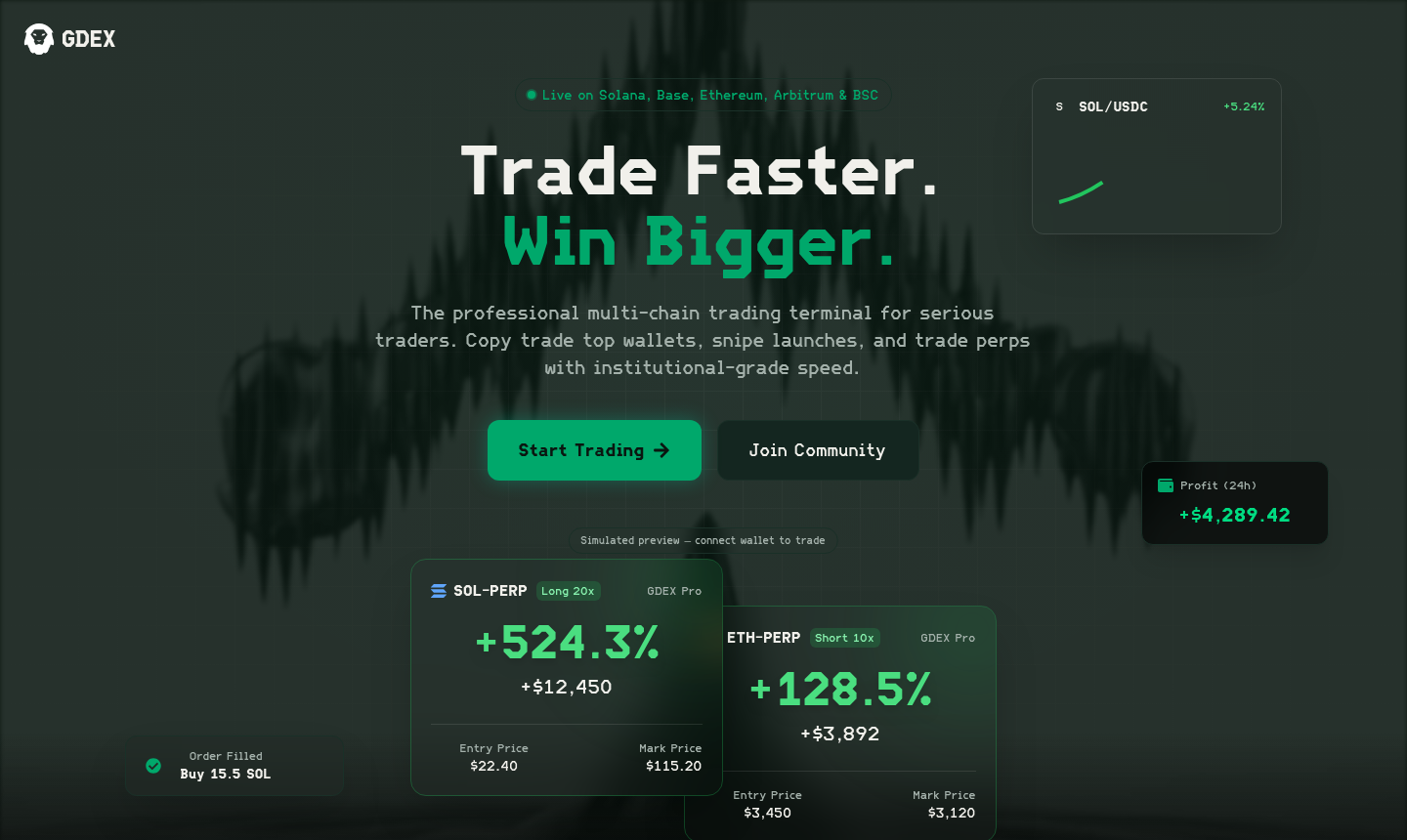
Go to gdex.pro in any browser — mobile Safari works fine, no app download is needed. Sign in with your Google or Apple account. Web3Auth threshold cryptography generates your self-custody wallet in the background; your private key is exportable at any time, and no seed phrase is issued.
Step 2: Locate the Network Selector
Once inside the terminal, find the network or chain selector control — it displays your currently active chain. Select the chain you want to work on from the list of nine supported networks. The terminal updates to show assets, prices, and swap options relevant to that chain.
Step 3: Fund the Chain You Need
No KYC is required for GDEX signup-to-trade. Third-party on-ramp providers may require identity verification and apply eligibility restrictions. GDEX swaps cost approximately 1%. Third-party Apple Pay on-ramp fees are approximately 2–3%, with a $50 minimum stated in the FAQ. Provider documentation differs; check the live minimum. Review the exact quote before confirming; network fees and slippage are separate.
Step 4: Bridge Between Chains if Needed
If you already hold funds on one chain and want to move them to another, use a cross-chain bridge of your choice to send assets to your GDEX wallet address on the destination chain. Your GDEX wallet address is visible for each network inside the terminal — select the destination chain first, then copy the deposit address.
Step 5: Execute Your Swap or Trade
With funds on the active chain, use GDEX Pro's swap aggregator to trade. The swap fee is approximately 1%. For perpetuals trading, access HyperLiquid perps through the terminal regardless of which spot chain you are currently on.
Step 6: Repeat Across Chains as Needed
Switch to a different chain using the network selector and repeat the process. Because all the nine highlighted networks share one GDEX account, there is no re-authentication or wallet import required — just select the next chain and trade. Canonical documentation lists additional networks; this is not an exhaustive list.
Understanding Fees When Trading Across Chains
Every chain switch that involves moving funds has a cost. The GDEX Pro swap fee is approximately 1% per trade, applied on the chain you are trading on. If you use the Apple Pay on-ramp to fund a chain, expect an additional approximately 2–3% on-ramp fee on top of the swap fee for that first purchase.
Bridging assets between chains using a third-party bridge will incur that bridge's own fees plus gas on both the source and destination chains. Gas costs vary significantly: Solana and Base tend to be cheap, while Ethereum mainnet can be expensive during congestion. Factor these costs in before deciding whether to bridge or simply on-ramp fresh funds onto the destination chain.
- Swap fee: ~1% per trade on any chain
- Apple Pay on-ramp: ~2–3% fee, $50 minimum, signup-to-trade without KYC No KYC is required for GDEX signup-to-trade. Third-party on-ramp providers may require identity verification and apply eligibility restrictions.
- Bridge fees: set by the bridge you use, not by GDEX Pro
- Gas fees: vary by chain — Ethereum is highest, Solana and Base are lowest
- Check current transaction limits and network or provider charges before proceeding.
Self-Custody Across All the nine highlighted networks
GDEX Pro uses Web3Auth threshold cryptography to generate your wallet when you sign in with Google or Apple. This means you never receive a seed phrase during setup, but your private key is always exportable — you are not locked into the GDEX interface. If the terminal were ever unavailable, you could import your key into any compatible wallet and access your funds directly on each chain.
This architecture is meaningfully different from a centralized exchange, where the platform holds your funds. With GDEX Pro, assets on each of the nine highlighted networks sit in your own wallet addresses. No platform holds custody. That said, self-custody means you are solely responsible for your key security — if you export your private key, store it securely offline. Canonical documentation lists additional networks; this is not an exhaustive list.
AI Agent Slots and Multichain Strategy
The FAQ describes mirroring up to 6 AI agent wallets through copy trading. Risk presets belong to the separate Agent Risk Terminal, which documents up to five running agents. These are different features with different controls; review the current documentation before allocating funds.
This is particularly relevant for multichain traders who want exposure to several ecosystems at once. You might run a conservative agent on a more established chain while setting an aggressive preset on a newer network like Berachain or Sonic. The agents are configurable, not a fixed roster — you decide how each slot is used.
Risks of Multichain Trading
Trading across the nine highlighted networks amplifies both opportunity and risk. Each additional chain introduces its own smart contract risks, bridge risks if you are moving funds, and liquidity conditions. Newer chains like Sonic and Berachain may have thinner liquidity and higher volatility than Ethereum or Solana. Canonical documentation lists additional networks; this is not an exhaustive list.
Bridging funds is one of the highest-risk operations in crypto. Only use reputable, audited bridges, verify destination addresses carefully, and never bridge more than you can afford to lose in a worst-case scenario. On-ramping fresh funds via Apple Pay onto each chain separately avoids bridge risk entirely, at the cost of the on-ramp fee.
No trading terminal, including GDEX Pro, can protect you from bad trades, rug pulls, or market volatility. Multichain diversification does not reduce market risk — it changes the nature of your exposure. Always size positions according to your own risk tolerance.
Frequently Asked Questions
How many chains does GDEX Pro support?
GDEX Pro supports the nine highlighted networks: Solana, Ethereum, Base, BNB Chain, Arbitrum, Optimism, Sui, Sonic, and Berachain. All nine are accessible from a single self-custody account. Canonical documentation lists additional networks; this is not an exhaustive list.
Do I need a different wallet for each chain on GDEX Pro?
No. GDEX Pro generates one self-custody wallet via Web3Auth when you sign in with Google or Apple. That single account covers all nine supported chains — you switch networks inside the terminal without creating separate wallets.
Can I buy crypto on any chain with Apple Pay on GDEX Pro?
Yes. The Apple Pay on-ramp works across the supported chains, with a $50 minimum purchase, no KYC requirement for GDEX signup-to-trade, and an approximately 2–3% on-ramp fee. Select the chain you want to fund before initiating the on-ramp. No KYC is required for GDEX signup-to-trade. Third-party on-ramp providers may require identity verification and apply eligibility restrictions.
What is the swap fee on GDEX Pro?
GDEX Pro charges approximately 1% per swap. This applies across all nine supported chains. Separate bridge fees and gas fees apply if you are moving funds between chains.
Is GDEX Pro safe for multichain trading?
GDEX Pro is a self-custody terminal, meaning your funds are held in your own wallet addresses, not by the platform. Your private key is exportable at any time. However, self-custody means you bear full responsibility for key security, and all crypto trading carries inherent market and smart contract risks.
Do I need to download an app to use GDEX Pro on multiple chains?
No. GDEX Pro works in any browser, including mobile Safari, with no app download required. Sign in with Google or Apple to access all the nine highlighted networks. Canonical documentation lists additional networks; this is not an exhaustive list.
What is the cheapest chain to trade on in GDEX Pro?
Solana and Base typically have the lowest gas fees among the nine supported chains. Ethereum mainnet tends to be the most expensive, especially during periods of network congestion. The GDEX Pro swap fee of approximately 1% is the same across all chains.
Can I trade perpetuals on GDEX Pro across all chains?
GDEX Pro offers perpetuals trading via HyperLiquid, accessible through the terminal. This is available regardless of which of the nine spot chains you are currently working on.
Bottom Line
GDEX Pro is a practical choice for traders who want to work across multiple chains without managing separate wallets or accounts. The combination of nine supported chains, a signup-to-trade without KYC Apple Pay on-ramp with a $50 minimum, and a single Web3Auth self-custody wallet makes multichain trading meaningfully more accessible than juggling standalone tools. The approximately 1% swap fee and approximately 2–3% on-ramp fee are real costs to factor into your strategy, and bridging funds between chains carries its own risks that GDEX Pro does not eliminate. Used with appropriate position sizing and an understanding of the fees involved, it is a capable terminal for traders who operate across the EVM ecosystem, Solana, and newer chains like Sui, Sonic, and Berachain. No KYC is required for GDEX signup-to-trade. Third-party on-ramp providers may require identity verification and apply eligibility restrictions.
Self-custody. $50 minimum. No KYC.