Quick Answer
You can day trade crypto without an exchange account using GDEX Pro, a self-custody multi-chain trading terminal at gdex.pro. Fund your wallet subject to processing and network conditions via Apple Pay (signup-to-trade without KYC, $50 minimum, ~2-3% on-ramp fee), then execute fast swaps across the nine highlighted networks at ~1% per swap and set limit orders — all without handing custody of your funds to any centralized platform. Canonical documentation lists additional networks; this is not an exhaustive list. No KYC is required for GDEX signup-to-trade. Third-party on-ramp providers may require identity verification and apply eligibility restrictions.
Check each platform’s current documentation for supported features, fees and access requirements. This guide does not establish a comparative performance or security ranking.
GDEX Pro is a self-custody trading terminal — not a DEX and not a CEX. It aggregates liquidity across 9 blockchains and lets you sign in with Google or Apple, fund via Apple Pay, and trade within minutes. Your private key is controlled by you through Web3Auth threshold cryptography, and it is exportable at any time. Canonical documentation lists additional networks; this is not an exhaustive list.
This guide walks through the exact workflow: getting funds on-chain, executing fast in-and-out swaps, using limit orders to manage entries and exits, and understanding the real costs involved. Every step is possible without a centralized exchange account.
How GDEX Pro Compares
GDEX Pro vs. popular Solana trading terminals for no-KYC day trading
| Spec | GDEX Pro | BullX | Photon |
|---|---|---|---|
| Chains supported | 9 (Solana, ETH, Base, BNB, Arbitrum, Optimism, Sui, Sonic, Berachain) | Primarily Solana and ETH | Primarily Solana |
| Fiat on-ramp | Apple Pay, $50 min, signup-to-trade without KYC, ~2-3% fee No KYC is required for GDEX signup-to-trade. Third-party on-ramp providers may require identity verification and apply eligibility restrictions. | No native fiat on-ramp | No native fiat on-ramp |
| Swap fee | ~1% | ~1% (varies by plan) | ~1% |
| KYC required | No | No | No |
| Self-custody | Yes — Web3Auth, key exportable | Yes | Yes |
| Perpetuals | Yes — HyperLiquid | No | No |
| AI copy-trading | Yes — up to 6 AI agent wallets | No | No |
| Login method | Google or Apple, no app download | Wallet connect / Telegram | Wallet connect / Telegram |
Step-by-Step Guide
Step 1: Open GDEX Pro in Your Browser
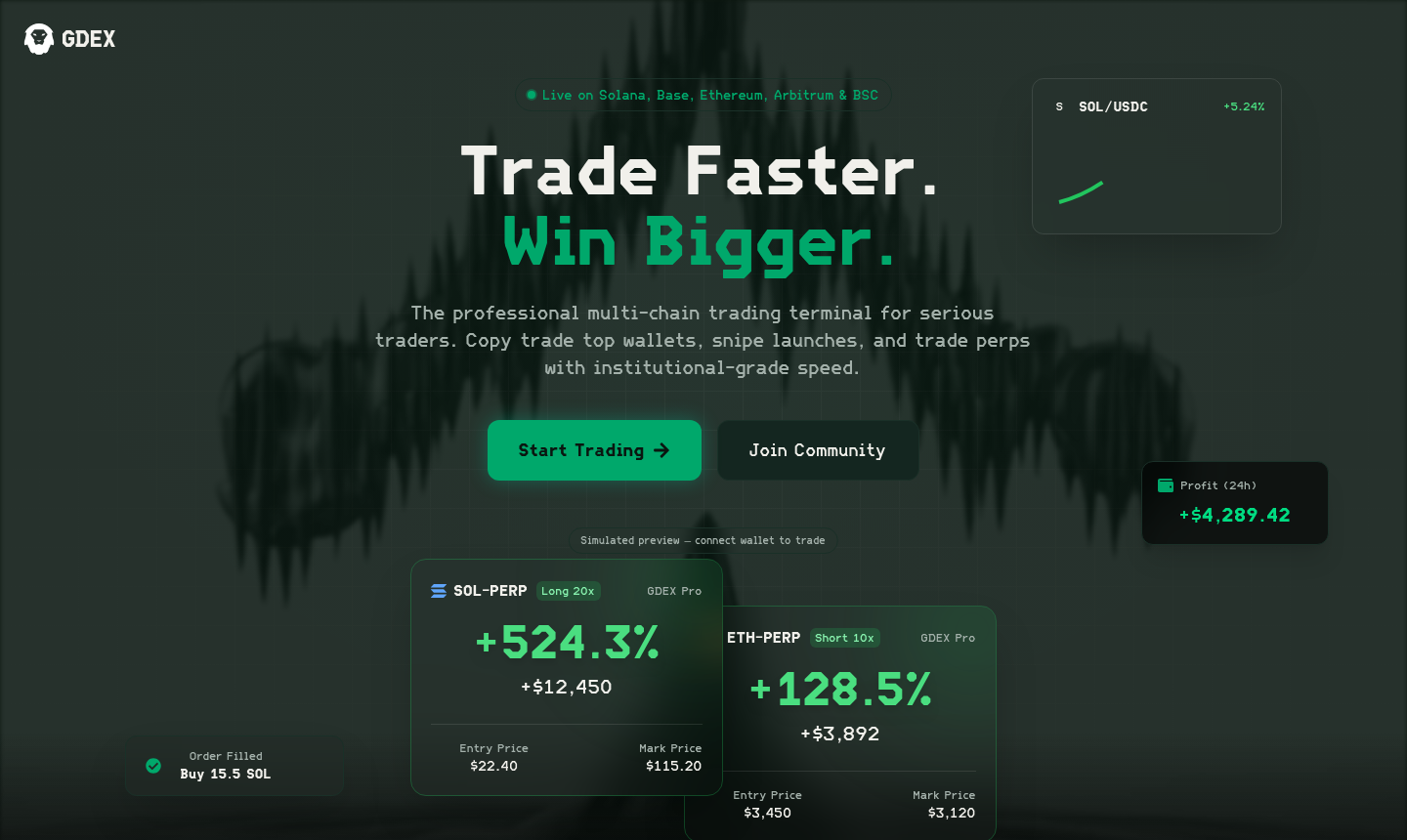
Navigate to gdex.pro in any browser — including mobile Safari. There is no app to download. Sign in with your Google or Apple account; Web3Auth threshold cryptography generates your self-custody wallet on the spot, and no seed phrase is issued (though your private key is exportable later if you want it).
Step 2: Fund Your Wallet via Apple Pay
Open the deposit screen and select the Apple Pay on-ramp. The minimum deposit is $50, and the fee is approximately 2-3% of the amount you send. signup-to-trade without KYC or identity documents are required. Choose the chain you want to trade on — for example, Solana for memecoins or Arbitrum for DeFi tokens — and the funds arrive on-chain in your self-custody wallet within minutes. No KYC is required for GDEX signup-to-trade. Third-party on-ramp providers may require identity verification and apply eligibility restrictions.
Step 3: Identify Your Trade and Select the Token
Use GDEX Pro's terminal to find the token you want to trade. Check the price chart and liquidity before committing. For day trading, focus on tokens with meaningful on-chain volume so your swap does not move the price significantly against you.
Step 4: Execute a Fast Swap (~1% Fee)
Enter the token pair you want to trade and confirm the swap. GDEX Pro routes through aggregated liquidity and charges approximately 1% per swap. For a fast in-and-out day trade, budget for two swaps — one to enter and one to exit — meaning roughly 2% in swap fees alone before any price movement is factored in.
Step 5: Set a Limit Order for Your Exit
Rather than watching the screen constantly, place a limit order at your target exit price. This lets you define your profit target or stop level in advance and step away from the terminal. Limit orders are available within the GDEX Pro interface across supported chains.
Step 6: Exit the Trade and Assess Your P&L
When your limit order fills — or if you choose to exit manually — review your net result. Subtract the on-ramp fee (one-time, ~2-3%), the entry swap fee (~1%), and the exit swap fee (~1%) from your gross gain to calculate real profit. If you are trading on perpetuals, you can access HyperLiquid perps directly through GDEX Pro for leveraged exposure without holding the underlying token.
Understanding the Real Cost of a Day Trade on GDEX Pro
Every round-trip day trade on GDEX Pro carries three layers of cost. First, the on-ramp fee of approximately 2-3% applies once when you move fiat to on-chain funds via Apple Pay. Second, each swap costs approximately 1%, so a complete entry-and-exit cycle costs roughly 2% in swap fees. In total, your first trade of the day costs around 4-5% before any price movement.
This means a day trade needs to capture at least 5% of price movement to break even on fees alone. That is not unusual for volatile crypto assets, but it is a number you must keep front of mind. Traders who churn positions multiple times per day will see fees compound quickly. Use limit orders to target meaningful moves rather than scalping tiny price increments.
- On-ramp fee: ~2-3% (one-time per funding session)
- Entry swap fee: ~1%
- Exit swap fee: ~1%
- Total round-trip cost estimate: ~4-5% for the first trade
- Perpetuals via HyperLiquid avoid per-swap fees but carry leverage risk
Why Self-Custody Matters for Day Traders
Published wallet documentation describes user-controlled, exportable private keys. Agent execution is separately documented as using server-side managed wallets. Review permissions, recovery and the custody model for the feature you use; self-custody does not remove every risk.
For day traders, this means you can move funds off the platform subject to processing and network conditions, switch chains, or migrate to a different tool without waiting for a withdrawal approval. There is no account to get flagged or frozen.
Using AI Agent Slots to Automate Parts of Your Strategy
The FAQ describes mirroring up to 6 AI agent wallets through copy trading. Risk presets belong to the separate Agent Risk Terminal, which documents up to five running agents. These are different features with different controls; review the current documentation before allocating funds.
This is not an assured profit feature — automated strategies carry the same market risk as manual trades, and past behavior of any algorithm does not predict future results. Think of the agent slots as configurable automation tools, not a not established here source.
Risks You Must Understand Before Day-Trading On-Chain
On-chain trading carries risks that centralized platforms partially abstract away. Slippage on low-liquidity tokens can mean you pay significantly more than the quoted price. Smart contract bugs in the protocols GDEX Pro routes through are a real, if rare, risk. Token prices on newer chains like Berachain or Sonic can be extremely volatile, and thin order books mean large moves on small trades.
Day trading crypto is high-risk regardless of the platform. The majority of retail day traders lose money over time, primarily due to fees, slippage, and emotional decision-making. Never trade capital you cannot afford to lose, and always verify the contract address of any token before swapping to avoid scam tokens.
- Slippage risk: higher on low-liquidity tokens
- Smart contract risk: inherent to all on-chain swaps
- Volatility risk: especially acute on newer or smaller-cap chains
- Fee drag: ~4-5% round-trip cost requires meaningful price moves to profit
- Scam tokens: always verify contract addresses independently
Frequently Asked Questions
Can I day trade crypto without a Coinbase or Binance account?
Yes. GDEX Pro lets you fund a self-custody wallet via Apple Pay with signup-to-trade without KYC and trade across the nine highlighted networks at approximately 1% per swap. You never need to create a centralized exchange account. Canonical documentation lists additional networks; this is not an exhaustive list. No KYC is required for GDEX signup-to-trade. Third-party on-ramp providers may require identity verification and apply eligibility restrictions.
Is GDEX Pro safe to use?
GDEX Pro uses Web3Auth threshold cryptography, meaning your private key is not held by any single server and is exportable by you at any time. However, on-chain trading carries smart contract and market risks that no platform can eliminate.
What is the minimum amount I need to start day trading on GDEX Pro?
The Apple Pay on-ramp has a $50 minimum. After the approximately 2-3% on-ramp fee and two swap fees for a round trip, you would need a meaningful price move to profit, so starting with a larger amount improves the math.
Does GDEX Pro require KYC or ID verification?
No. You sign in with Google or Apple and fund via Apple Pay with no identity documents required. No KYC is required for GDEX signup-to-trade. Third-party on-ramp providers may require identity verification and apply eligibility restrictions.
What chains can I trade on with GDEX Pro?
GDEX Pro supports the nine highlighted networks: Solana, Ethereum, Base, BNB, Arbitrum, Optimism, Sui, Sonic, and Berachain. Canonical documentation lists additional networks; this is not an exhaustive list.
How much does it cost to trade on GDEX Pro?
Each swap costs approximately 1%. A full round-trip trade (buy and sell) costs roughly 2% in swap fees. If you also use the Apple Pay on-ramp, add a one-time fee of approximately 2-3% on the amount deposited.
Can I trade crypto perpetuals without a CEX account?
Yes. GDEX Pro provides access to HyperLiquid perpetuals directly through the terminal, giving you leveraged exposure without holding the underlying token and without a centralized exchange account.
How is GDEX Pro different from BullX or Photon?
Check each platform’s current documentation for supported features, fees and access requirements. This guide does not establish a comparative performance or security ranking.
Bottom Line
Day trading crypto without an exchange account is genuinely practical using GDEX Pro. The Apple Pay on-ramp removes the biggest barrier — getting fiat on-chain without KYC — and the approximately 1% swap fee is competitive with other self-custody terminals. The real constraint is fee math: a round-trip trade costs roughly 4-5% all-in, so this workflow suits traders targeting meaningful price moves on volatile assets, not micro-scalpers. Keep position sizing disciplined, verify every token contract before swapping, and never trade more than you can afford to lose. No KYC is required for GDEX signup-to-trade. Third-party on-ramp providers may require identity verification and apply eligibility restrictions.
Self-custody. $50 minimum. No KYC.