Quick Answer
One option is GDEX Pro (gdex.pro), which offers a built-in Apple Pay on-ramp with a $50 minimum deposit, signup-to-trade without KYC, and a fee of approximately 2-3%. Funds arrive directly into your self-custody wallet — secured by Web3Auth threshold cryptography — and are ready to swap across Solana, Ethereum, Base, and 6 other chains within minutes. No KYC is required for GDEX signup-to-trade. Third-party on-ramp providers may require identity verification and apply eligibility restrictions.
No KYC is required for GDEX signup-to-trade. Third-party on-ramp providers may require identity verification and apply eligibility restrictions. GDEX swaps cost approximately 1%. Third-party Apple Pay on-ramp fees are approximately 2–3%, with a $50 minimum stated in the FAQ. Provider documentation differs; check the live minimum. Review the exact quote before confirming; network fees and slippage are separate.
GDEX Pro is a self-custody, multi-chain trading terminal that includes a built-in fiat on-ramp powered by Apple Pay. You sign in with Google or Apple, open the deposit screen, and pay with your debit card — the same way you would buy anything online. No exchange account. signup-to-trade without KYC. No seed phrase to write down. No KYC is required for GDEX signup-to-trade. Third-party on-ramp providers may require identity verification and apply eligibility restrictions.
This guide covers exactly how the process works, what fees to expect, how long it takes, and what to watch out for before you tap that Pay button.
How GDEX Pro Compares
GDEX Pro vs. BullX and Photon: fiat on-ramp and self-custody comparison
| Spec | GDEX Pro | BullX | Photon |
|---|---|---|---|
| Fiat on-ramp | Apple Pay, $50 min, signup-to-trade without KYC No KYC is required for GDEX signup-to-trade. Third-party on-ramp providers may require identity verification and apply eligibility restrictions. | No native fiat on-ramp | No native fiat on-ramp |
| On-ramp fee | ~2-3% | N/A | N/A |
| KYC required | No | No | No |
| Chains supported | 9 | Solana, Base, others | Primarily Solana |
| Self-custody | Yes, Web3Auth threshold cryptography | Yes | Yes |
| Seed phrase | Not required (key exportable) | Required | Required |
| App download required | No | No | No |
Step-by-Step Guide
Open GDEX Pro in your browser
Navigate to gdex.pro in any browser — mobile Safari, Chrome, or desktop. No app download is required. GDEX Pro runs entirely in the browser.
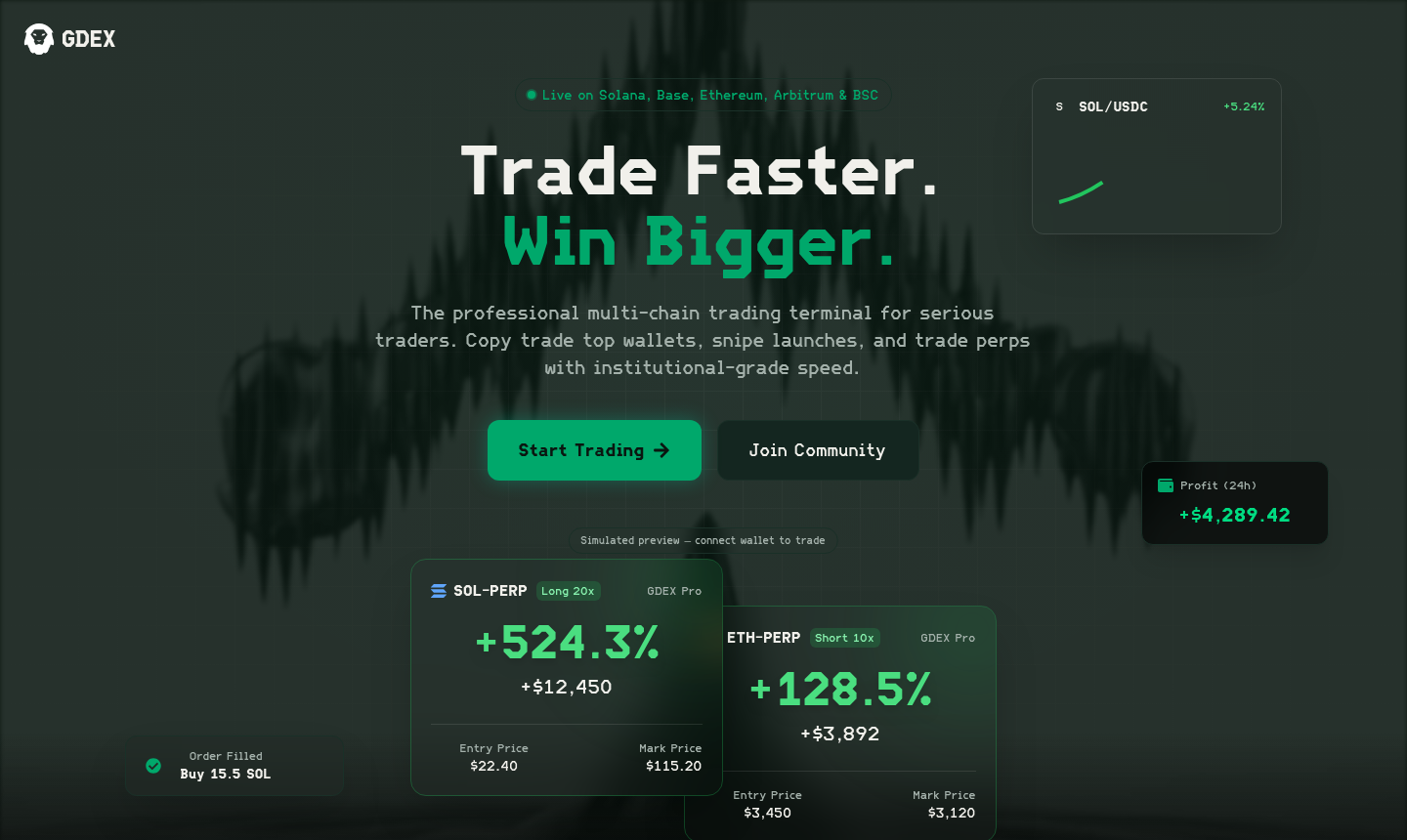
Sign in with Google or Apple
Select sign-in with Google or Apple. GDEX Pro uses Web3Auth threshold cryptography to generate your self-custody wallet on the spot — no seed phrase is issued at this stage, though your private key is exportable later if you want it.
Select the network you want to fund
Choose which of the 9 supported chains you want to receive funds on — for example, Solana for memecoins or Base for Ethereum-ecosystem tokens. The on-ramp deposits the native asset of that chain directly to your wallet.
Open the deposit or on-ramp screen and enter your amount
Open the deposit screen and enter the fiat amount you want to spend. The minimum is $50. You will see an estimated fee of approximately 2-3% and the amount of crypto you will receive before you confirm.
Complete payment with Apple Pay
Authorize the payment using Apple Pay with your debit card. On mobile Safari this uses Face ID or Touch ID; on desktop it uses the Apple Pay prompt on your paired device. No card details are entered manually into GDEX Pro.
Confirm funds have arrived and start trading
Funds typically arrive in your GDEX Pro wallet within minutes. Once the balance appears, you can swap tokens across any of the 9 supported chains at a swap fee of approximately 1%.
Understanding the Fees
There are two separate fees to understand when funding GDEX Pro with a debit card. The on-ramp fee is approximately 2-3% of the fiat amount you deposit. This is charged at the point of purchase and covers the cost of converting your card payment into on-chain crypto. It is deducted before the crypto reaches your wallet, so if you deposit $100 you will receive roughly $97-98 worth of the target asset.
Once funds are in your wallet, any token swap you make inside GDEX Pro carries a separate swap fee of approximately 1%. These two fees are independent — you only pay the on-ramp fee once when you fund, and then the 1% swap fee each time you trade. For context, a $50 deposit at 2.5% on-ramp fee costs $1.25 to get funds on-chain, which is competitive with most fiat-to-crypto services that also require KYC.
- On-ramp fee: ~2-3% (charged once at deposit)
- Swap fee: ~1% (charged per trade)
- Minimum deposit: $50
- Check current transaction limits and network or provider charges before proceeding.
How Fast Do Funds Arrive?
Because GDEX Pro's Apple Pay on-ramp settles directly to your self-custody wallet on-chain, arrival time depends on the network you selected. Solana and Base transactions typically confirm within seconds to a couple of minutes. Ethereum mainnet can take longer depending on network congestion, though it is rarely more than a few minutes under normal conditions.
No KYC is required for GDEX signup-to-trade. Third-party on-ramp providers may require identity verification and apply eligibility restrictions. GDEX swaps cost approximately 1%. Third-party Apple Pay on-ramp fees are approximately 2–3%, with a $50 minimum stated in the FAQ. Provider documentation differs; check the live minimum. Review the exact quote before confirming; network fees and slippage are separate.
Risks and Honest Caveats
Self-custody means you are solely responsible for your wallet. GDEX Pro uses Web3Auth threshold cryptography so you do not need a seed phrase to sign in, but you should export and securely store your private key if you plan to hold significant funds. If you lose access to your Google or Apple account and have not exported your key, recovery options may be limited.
The ~2-3% on-ramp fee is a real cost. For very small deposits just above the $50 minimum, this fee represents a meaningful percentage of your trading capital. Factor it into your plan — if you are depositing $50 to trade memecoins, you are starting with roughly $48-49 after the on-ramp fee, before any swap fees.
Crypto prices are volatile. Funding your wallet with a debit card does not guarantee any return, and tokens purchased after funding can lose value rapidly. Only deposit what you can afford to lose.
Why Use GDEX Pro Instead of a Centralized Exchange?
Compare each platform’s current custody, key-export and recovery documentation directly. The published wallet documentation describes user-controlled, exportable private keys. Agent execution is separately documented as using server-side managed wallets; review that model before enabling automation. Secure your sign-in account and any exported backup. Self-custody does not eliminate interface, account, smart-contract or market risk.
Compare each platform’s current custody, key-export and recovery documentation directly. The published wallet documentation describes user-controlled, exportable private keys. Agent execution is separately documented as using server-side managed wallets; review that model before enabling automation. Secure your sign-in account and any exported backup. Self-custody does not eliminate interface, account, smart-contract or market risk.
Frequently Asked Questions
Can I fund crypto with a debit card and no KYC?
No KYC is required for GDEX signup-to-trade. Third-party on-ramp providers may require identity verification and apply eligibility restrictions. GDEX swaps cost approximately 1%. Third-party Apple Pay on-ramp fees are approximately 2–3%, with a $50 minimum stated in the FAQ. Provider documentation differs; check the live minimum. Review the exact quote before confirming; network fees and slippage are separate.
What is the minimum deposit on GDEX Pro?
The minimum deposit via the Apple Pay on-ramp is $50. Check current transaction limits and network or provider charges before proceeding.
How much does it cost to fund GDEX Pro with a debit card?
The Apple Pay on-ramp charges approximately 2-3% of the deposit amount. A $100 deposit costs roughly $2-3 in fees. Separate from this, each token swap inside GDEX Pro costs approximately 1%.
How long does it take for funds to arrive after using Apple Pay on GDEX Pro?
Funds typically arrive within a few minutes. On fast chains like Solana or Base, the balance usually appears subject to processing and network conditions of completing the Apple Pay authorization.
Is GDEX Pro safe to use without a seed phrase?
GDEX Pro uses Web3Auth threshold cryptography, which generates a self-custody wallet without issuing a seed phrase. Your private key is exportable, and you should export and store it securely if you plan to hold significant funds, since losing access to your sign-in account without a backed-up key could limit recovery options.
Does GDEX Pro work on iPhone without downloading an app?
Yes. GDEX Pro runs in any mobile browser including Safari on iPhone. No app download is required, and Apple Pay works natively in mobile Safari for the on-ramp.
What chains can I fund with the GDEX Pro Apple Pay on-ramp?
GDEX Pro supports the nine highlighted networks: Solana, Ethereum, Base, BNB, Arbitrum, Optimism, Sui, Sonic, and Berachain. You select the target chain before completing the Apple Pay payment. Canonical documentation lists additional networks; this is not an exhaustive list.
Do BullX or Photon have a debit card on-ramp like GDEX Pro?
Compare each platform’s current custody, key-export and recovery documentation directly. The published wallet documentation describes user-controlled, exportable private keys. Agent execution is separately documented as using server-side managed wallets; review that model before enabling automation. Secure your sign-in account and any exported backup. Self-custody does not eliminate interface, account, smart-contract or market risk.
Bottom Line
No KYC is required for GDEX signup-to-trade. Third-party on-ramp providers may require identity verification and apply eligibility restrictions. GDEX swaps cost approximately 1%. Third-party Apple Pay on-ramp fees are approximately 2–3%, with a $50 minimum stated in the FAQ. Provider documentation differs; check the live minimum. Review the exact quote before confirming; network fees and slippage are separate.
Self-custody. $50 minimum. No KYC.