Quick Answer
Compare supported markets, complete quoted costs, access requirements, wallet permissions and recovery. This guide does not establish an overall performance or security ranking.
Most people assume self-custody means writing down 12 or 24 words on a piece of paper and hoping they never lose it. That mental model is outdated. GDEX Pro, the multi-chain trading terminal built by GemachDAO, uses Web3Auth threshold cryptography to create a self-custody Solana wallet that is secured by your existing Google or Apple account — and you can export the underlying private key whenever you want.
The result is a wallet that takes under 60 seconds to create, works in any browser without an extension or app download, and still meets the core definition of self-custody: only you control the private key. There is no GDEX server that holds your funds or can freeze your account.
This guide walks you through the exact steps to go from zero to a funded, trade-ready self-custody Solana wallet on GDEX Pro, explains how the threshold cryptography actually works, and covers the real fees and risks you should know before you start.
How GDEX Pro Compares
GDEX Pro vs. Solana trading terminals: wallet setup and self-custody features
| Spec | GDEX Pro | Photon | Trojan |
|---|---|---|---|
| Wallet type | Web3Auth self-custody, key exportable | Browser extension or connected wallet | Telegram bot, custodial by default |
| Setup time | Under 60 seconds, browser only | Requires extension install | Requires Telegram account linking |
| Seed phrase required | No — social login only | Yes, standard wallet seed | No, but you do not own the key |
| Private key exportable | Yes | Yes (from connected wallet) | No |
| Fiat on-ramp | Apple Pay, $50 min, signup-to-trade without KYC No KYC is required for GDEX signup-to-trade. Third-party on-ramp providers may require identity verification and apply eligibility restrictions. | Not natively built in | Not natively built in |
| Chains supported | 9 | Solana-focused | Solana-focused |
| KYC required | No | No | No |
Step-by-Step Guide
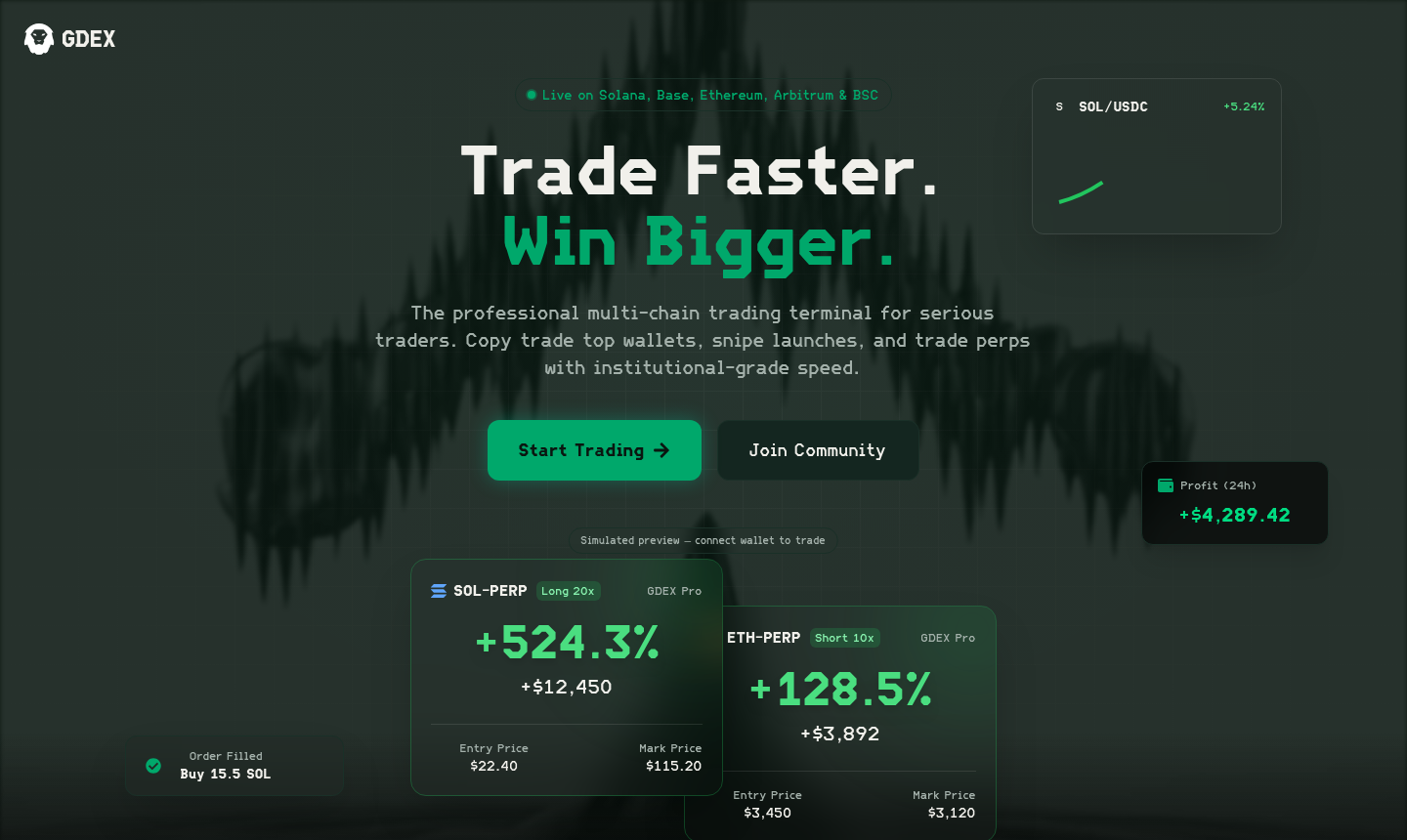
Open GDEX Pro in your browser
Navigate to gdex.pro in any browser — Chrome, Firefox, Brave, or mobile Safari on iPhone all work. There is no app to download and no browser extension required.
Sign in with Google or Apple
Published wallet documentation describes user-controlled, exportable private keys. Agent execution is separately documented as using server-side managed wallets. Review permissions, recovery and the custody model for the feature you use; self-custody does not remove every risk.
Your self-custody wallet is created instantly
The published wallet documentation describes user-controlled, exportable private keys. Agent execution is separately documented as using server-side managed wallets; review that model before enabling automation. Secure your sign-in account and any exported backup. Self-custody does not eliminate interface, account, smart-contract or market risk.
Export your private key (optional but recommended)
Go to wallet settings and use the key-export function to view and copy your raw private key. Store it somewhere secure offline; this step confirms you have full self-custody and can access your funds in any other Solana wallet like Phantom or Solflare.
Fund your wallet via Apple Pay
Use the built-in fiat on-ramp to buy crypto directly into your new wallet with Apple Pay. The minimum is $50, there is no KYC required for GDEX signup-to-trade, and the on-ramp fee is approximately 2 to 3 percent. No KYC is required for GDEX signup-to-trade. Third-party on-ramp providers may require identity verification and apply eligibility restrictions.
Start trading on Solana
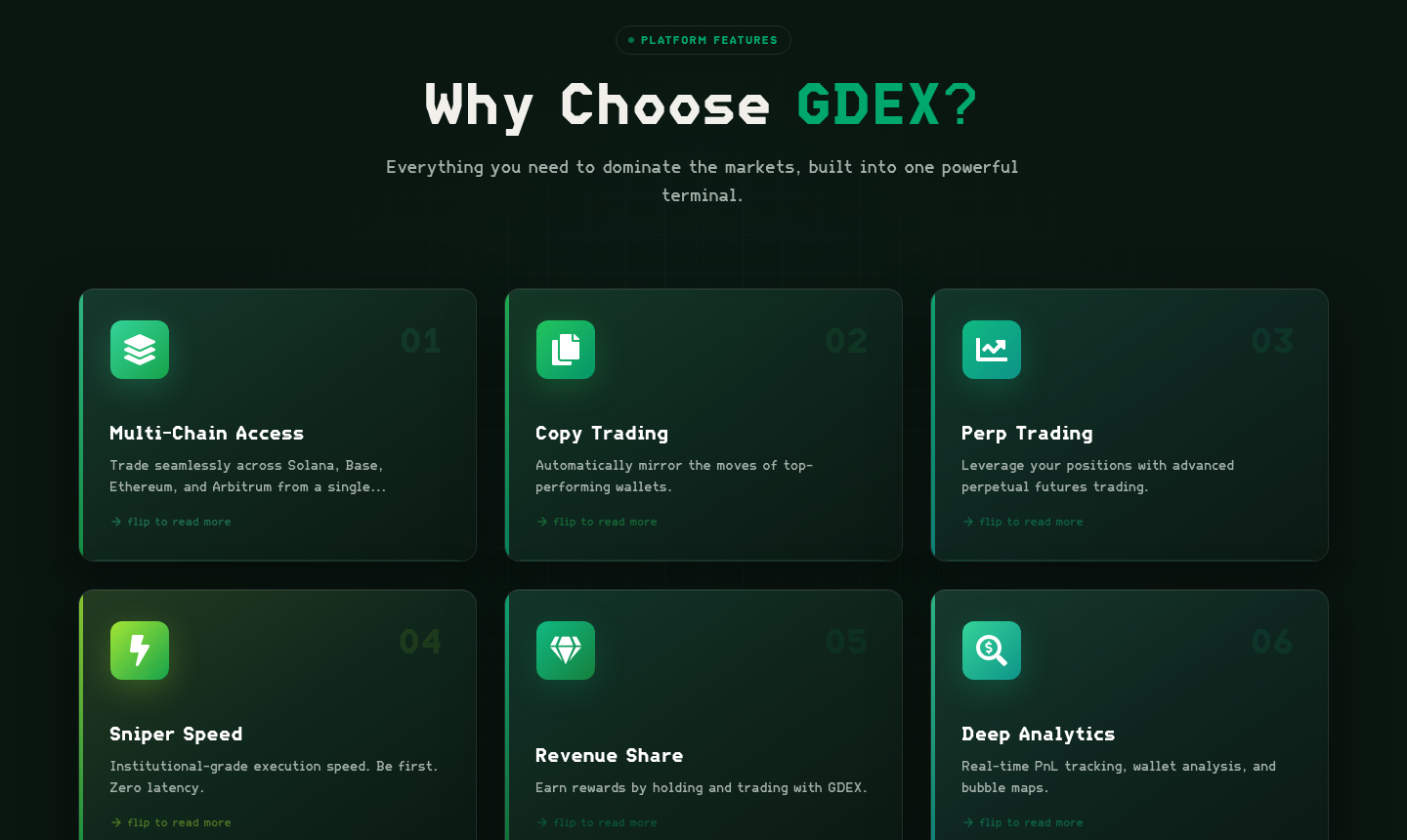
Your wallet is now ready to swap tokens across 9 supported chains including Solana, Ethereum, Base, and BNB. Swap fees are approximately 1 percent, and you can optionally configure one of up to 6 AI agent wallets for copy-trading.
How Web3Auth Threshold Cryptography Actually Works
Published wallet documentation describes user-controlled, exportable private keys. Agent execution is separately documented as using server-side managed wallets. Review permissions, recovery and the custody model for the feature you use; self-custody does not remove every risk.
Published wallet documentation describes user-controlled, exportable private keys. Agent execution is separately documented as using server-side managed wallets. Review permissions, recovery and the custody model for the feature you use; self-custody does not remove every risk.
Published wallet documentation describes user-controlled, exportable private keys. Agent execution is separately documented as using server-side managed wallets. Review permissions, recovery and the custody model for the feature you use; self-custody does not remove every risk.
Fees You Will Actually Pay
No KYC is required for GDEX signup-to-trade. Third-party on-ramp providers may require identity verification and apply eligibility restrictions. GDEX swaps cost approximately 1%. Third-party Apple Pay on-ramp fees are approximately 2–3%, with a $50 minimum stated in the FAQ. Provider documentation differs; check the live minimum. Review the exact quote before confirming; network fees and slippage are separate.
Compare supported markets, complete quoted costs, access requirements, wallet permissions and recovery. This guide does not establish an overall performance or security ranking.
- Apple Pay on-ramp: ~2-3% fee, $50 minimum, signup-to-trade without KYC No KYC is required for GDEX signup-to-trade. Third-party on-ramp providers may require identity verification and apply eligibility restrictions.
- Swap fee: ~1% per trade
- No subscription or account fee mentioned
- 30% of GDEX's net trading fee from direct referrals and 10% from their referrals, no cap. Earnings depend on referral activity and aren't guaranteed.
Risks and Honest Limitations
Self-custody always means personal responsibility. If you lose access to both your Google or Apple account and your exported private key, you lose access to your funds permanently. There is no customer support team that can recover a self-custody wallet. Exporting and securely storing your private key offline is not optional — it is the step that makes your custody real.
Web3Auth's threshold model significantly reduces the risk of a single point of failure compared to a traditional seed phrase, but it introduces a dependency on Web3Auth's infrastructure for day-to-day access. If you have exported your private key, this dependency is eliminated. If you have not, you should treat your Google or Apple account security as a direct line of defense for your crypto holdings — use a strong password and two-factor authentication.
Crypto trading carries significant financial risk. Token prices on Solana, especially memecoins, can fall to zero rapidly. GDEX Pro's AI copy-trading feature mirrors agent wallets, but past performance of any trading strategy does not guarantee future results. Never trade more than you can afford to lose entirely.
Why This Matters vs. Custodial Alternatives
Compare each platform’s current custody, key-export and recovery documentation directly. The published wallet documentation describes user-controlled, exportable private keys. Agent execution is separately documented as using server-side managed wallets; review that model before enabling automation. Secure your sign-in account and any exported backup. Self-custody does not eliminate interface, account, smart-contract or market risk.
Centralized exchanges require KYC, hold your funds, and can freeze accounts. GDEX Pro requires signup-to-trade without KYC, holds no funds, and cannot prevent you from accessing your wallet as long as you have your exported private key. For traders who value both ease of onboarding and genuine ownership, this combination is genuinely differentiated in the current market. No KYC is required for GDEX signup-to-trade. Third-party on-ramp providers may require identity verification and apply eligibility restrictions.
Frequently Asked Questions
Is GDEX Pro actually self-custody or does it hold my funds?
GDEX Pro is genuinely self-custody. It uses Web3Auth threshold cryptography so no single server, including GDEX's own, holds your complete private key. You can export your private key at any time and use it in any other Solana wallet.
Can I set up a Solana wallet on GDEX Pro without downloading an app?
Yes. GDEX Pro works entirely in the browser, including mobile Safari on iPhone. There is no app download and no browser extension required. Sign in with Google or Apple and your wallet is created subject to processing and network conditions.
What happens if I lose access to my Google account — do I lose my crypto?
If you have exported your private key and stored it securely, you can access your funds from any Solana wallet regardless of your Google account. If you have not exported your key and lose your Google account, recovery becomes very difficult, which is why key export is strongly recommended.
Does GDEX Pro require KYC to create a wallet or buy crypto?
No. GDEX Pro requires signup-to-trade without KYC for wallet creation or for the Apple Pay fiat on-ramp. The minimum on-ramp purchase is $50 and the fee is approximately 2 to 3 percent. No KYC is required for GDEX signup-to-trade. Third-party on-ramp providers may require identity verification and apply eligibility restrictions.
How long does it actually take to set up a self-custody Solana wallet on GDEX Pro?
Under 60 seconds. You navigate to gdex.pro, click sign in, authenticate with Google or Apple, and your self-custody Solana wallet address is generated immediately with no forms to fill out.
What is the swap fee on GDEX Pro?
The swap fee on GDEX Pro is approximately 1 percent per trade. This applies to token swaps across its supported chains, which include Solana, Ethereum, Base, BNB, Arbitrum, Optimism, Sui, Sonic, and Berachain.
Can I import my GDEX Pro wallet into Phantom or another Solana wallet?
Yes. Use the key-export feature in GDEX Pro wallet settings to retrieve your raw private key, then import it into Phantom, Solflare, or any other standard Solana wallet. This confirms full self-custody.
Is GDEX Pro safe for storing large amounts of crypto?
GDEX Pro's Web3Auth model is more secure than a simple custodial service, but no hot wallet is recommended for long-term storage of large amounts. Export your private key, secure it offline, and consider a hardware wallet for significant holdings. Never store more in any trading terminal than you are actively using to trade.
Bottom Line
GDEX Pro delivers on its promise of a self-custody Solana wallet in under 60 seconds. The Web3Auth threshold cryptography model is a legitimate approach to self-custody — not a marketing claim — and the private key export function is the proof. Fees are real: approximately 1 percent per swap and 2 to 3 percent on Apple Pay on-ramps, so this is a convenience-focused terminal rather than a cost-minimization tool. Export your private key the moment you create your wallet, secure your Google or Apple account with two-factor authentication, and never trade more than you can afford to lose.
Self-custody. $50 minimum. No KYC.