Quick Answer
To trade Arbitrum tokens on GDEX Pro, sign in with Google or Apple, switch the active network to Arbitrum, fund your self-custody wallet via Apple Pay ($50 minimum, signup-to-trade without KYC, roughly 2-3% on-ramp fee) or a direct crypto deposit, then swap any supported Arbitrum token for an approximately 1% swap fee. GDEX Pro is a self-custody, multi-chain trading terminal and swap aggregator covering the nine highlighted networks, including Arbitrum, Ethereum, Solana, and Base, so the same account and keys carry over when you switch networks. Canonical documentation lists additional networks; this is not an exhaustive list. No KYC is required for GDEX signup-to-trade. Third-party on-ramp providers may require identity verification and apply eligibility restrictions.
GDEX Pro is a self-custody, multi-chain trading terminal that lets you swap tokens across the nine highlighted networks, including Arbitrum, Ethereum, Solana, Base, BNB Chain, Optimism, Sui, Sonic, and Berachain, all from one account. It is not a decentralized exchange or a centralized exchange in the traditional sense; it functions as a swap aggregator and trading interface that routes your orders while you keep control of your own private keys. Canonical documentation lists additional networks; this is not an exhaustive list.
Arbitrum is one of the nine supported networks, and GDEX Pro treats it the same way it treats every other chain: you sign in once, switch the active network to Arbitrum inside the terminal, and trade using the same self-custody wallet you already set up. There is no separate Arbitrum-only wallet to create and no app to download, since GDEX Pro runs in mobile Safari or any browser.
Compare each platform’s current custody, key-export and recovery documentation directly. The published wallet documentation describes user-controlled, exportable private keys. Agent execution is separately documented as using server-side managed wallets; review that model before enabling automation. Secure your sign-in account and any exported backup. Self-custody does not eliminate interface, account, smart-contract or market risk.
How GDEX Pro Compares
GDEX Pro vs Solana-focused trading terminals when Arbitrum access is the priority
| Spec | GDEX Pro | BullX | Photon |
|---|---|---|---|
| Chains supported | the nine highlighted networks incl. Arbitrum, Ethereum, Solana, Base Canonical documentation lists additional networks; this is not an exhaustive list. | Solana plus several EVM chains | Solana only |
| Custody model | Self-custody, Web3Auth, no seed phrase | Self-custody, seed-phrase wallet | Self-custody, seed-phrase wallet |
| Sign-in method | Google or Apple, no app download | Wallet connect or browser extension | Wallet connect or browser extension |
| Fiat on-ramp | Apple Pay, $50 min, signup-to-trade without KYC, ~2-3% fee No KYC is required for GDEX signup-to-trade. Third-party on-ramp providers may require identity verification and apply eligibility restrictions. | Third-party on-ramp options vary | Third-party on-ramp options vary |
| Swap fee | ~1% flat | Platform fee applies, varies by route | Platform fee applies, varies by route |
| Perpetuals | Yes, via HyperLiquid | Not a native feature | Not a native feature |
Step-by-Step Guide
Sign in and create your self-custody account
Go to GDEX Pro and sign in with your Google or Apple account. GDEX Pro uses Web3Auth threshold cryptography to generate a self-custody wallet for you automatically, so there is no seed phrase to write down, though your private key remains exportable if you want it.
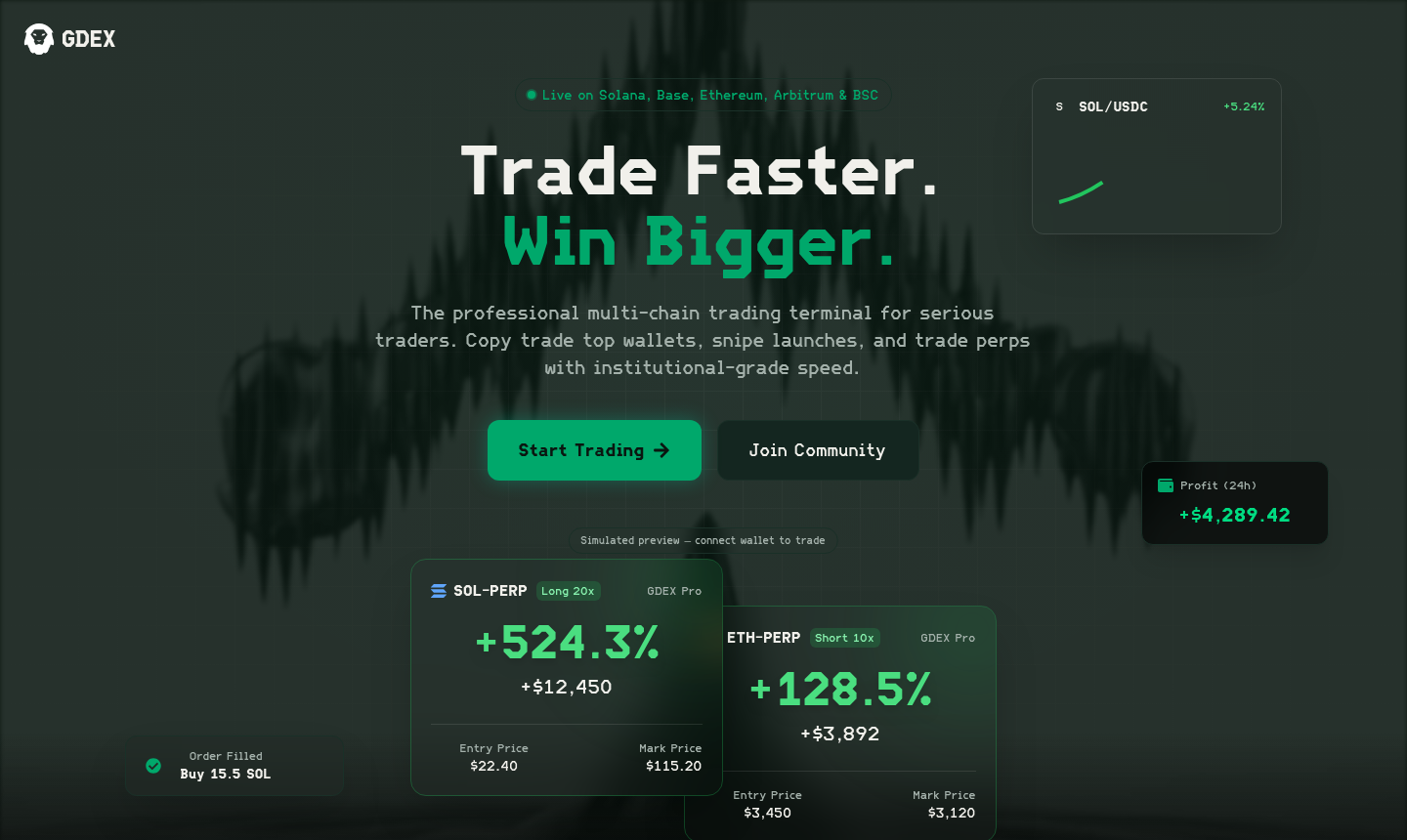
Switch the active network to Arbitrum
Use the network selector inside the terminal to switch from whatever chain you were on to Arbitrum. Your account and login stay the same across the highlighted networks, so switching networks does not create a new wallet or require re-authentication.
Fund your Arbitrum wallet
Deposit funds either by buying crypto directly with Apple Pay, which has a $50 minimum, requires signup-to-trade without KYC, and carries roughly a 2-3% on-ramp fee, or by sending ETH or tokens from an external wallet or exchange to your GDEX Arbitrum address. No KYC is required for GDEX signup-to-trade. Third-party on-ramp providers may require identity verification and apply eligibility restrictions.
Find and select the Arbitrum token you want to trade
Search for the token by name or paste its contract address to make sure you are trading the correct asset, then select it to open the swap screen. Always verify the contract address independently before trading a low-liquidity or unfamiliar token.
Review the swap and confirm
Check the amount, exchange rate, slippage, and fees on the swap screen. GDEX Pro charges a swap fee of approximately 1% on top of standard Arbitrum network gas, so confirm the total cost before you approve the trade.
Switch chains anytime from the same account
Once your Arbitrum trade is done, you can switch to any of the other 8 supported chains using the same login and self-custody wallet, without funding a separate account or repeating the sign-in process.
Why Trade Arbitrum Tokens on GDEX Pro
Most Solana-focused trading terminals do not support Arbitrum at all, which means traders who want exposure to both Solana meme coins and Arbitrum tokens usually juggle two or more separate apps and wallets. GDEX Pro puts the nine highlighted networks, including Arbitrum, behind a single account and a single sign-in. Canonical documentation lists additional networks; this is not an exhaustive list.
Because GDEX Pro is self-custody rather than a centralized exchange, you are not depositing funds into an exchange-controlled account when you move to Arbitrum. Your wallet, generated through Web3Auth, carries the same keys across every supported chain, so switching networks is a configuration change, not a new onboarding flow.
Fees and Costs to Expect
Trading Arbitrum tokens on GDEX Pro involves a few distinct costs. The swap fee itself is roughly 1% per trade. If you fund your account by buying crypto directly with Apple Pay, expect an additional on-ramp fee of about 2-3%, on top of the $50 minimum purchase.
You will also pay standard Arbitrum network gas fees on top of the GDEX swap fee, as with any on-chain transaction. Funding by direct crypto deposit from an external wallet or exchange avoids the Apple Pay on-ramp fee but still involves network gas to move the funds onto Arbitrum.
Risks and Self-Custody Responsibility
Self-custody means you are responsible for your own security. Your private key is exportable from GDEX Pro, and losing access to your Google or Apple sign-in without a backup could put your funds at risk, so treat your login credentials with the same care you would a seed phrase.
GDEX supports mirroring up to 6 AI agent wallets. Select a trader or agent, allocate funds and review the available controls. Copied trades can lose money and execution may differ from the source wallet.
- Always verify a token's contract address before swapping.
- Never share your GDEX sign-in credentials or exported private key.
- Treat the ~1% swap fee and any gas costs as sunk costs regardless of how the trade performs.
GDEX referral terms
30% of GDEX's net trading fee from direct referrals and 10% from their referrals, no cap. Earnings depend on referral activity and aren't guaranteed.
Frequently Asked Questions
Is GDEX Pro a decentralized exchange?
No, GDEX Pro is a self-custody, multi-chain trading terminal and swap aggregator, not a decentralized exchange or a centralized exchange. It routes swaps across the nine highlighted networks, including Arbitrum, while you retain control of your own private keys. Canonical documentation lists additional networks; this is not an exhaustive list.
Can I trade Arbitrum tokens without KYC?
Yes. GDEX Pro requires signup-to-trade without KYC to trade. You sign in with Google or Apple and can fund your account through Apple Pay ($50 minimum, roughly 2-3% on-ramp fee) or by depositing crypto directly. No KYC is required for GDEX signup-to-trade. Third-party on-ramp providers may require identity verification and apply eligibility restrictions.
What does it cost to swap tokens on Arbitrum through GDEX Pro?
GDEX Pro charges a swap fee of approximately 1% per trade, plus standard Arbitrum network gas fees. If you fund via Apple Pay, add roughly a 2-3% on-ramp fee on top.
Do I need a separate wallet to trade on Arbitrum?
No. Your GDEX Pro self-custody wallet works across the highlighted networks, including Arbitrum. You switch the active network in the terminal rather than creating a new wallet or account.
Is my crypto safe on GDEX Pro?
GDEX Pro uses Web3Auth threshold cryptography for self-custody, so you control your funds and there is no seed phrase to lose, and your private key is exportable. That said, self-custody means you are responsible for securing your sign-in, and normal crypto trading risks like volatility and smart contract risk still apply.
Can I trade Arbitrum perpetuals on GDEX Pro?
GDEX Pro offers perpetual futures trading through its HyperLiquid integration, which is a separate trading venue from spot token swaps on Arbitrum and the other 8 supported chains. Check the app to see which perpetual markets are currently listed.
How do I switch from another chain to Arbitrum on GDEX Pro?
Use the network selector inside the terminal to switch to Arbitrum. Your existing GDEX Pro account and self-custody wallet carry over, so no new sign-in or wallet setup is required.
Can I earn money by referring people to GDEX Pro?
30% of GDEX's net trading fee from direct referrals and 10% from their referrals, no cap. Earnings depend on referral activity and aren't guaranteed.
Bottom Line
GDEX Pro is a practical option for trading Arbitrum tokens if you want self-custody, signup-to-trade without KYC, and the ability to switch to Solana, Ethereum, Base, or six other chains from the same account. The tradeoffs are a ~1% swap fee plus network gas, and a 2-3% on-ramp fee if you fund with Apple Pay, so it is not the cheapest way to move fiat into crypto, but it removes the friction of running separate wallets per chain. As with any self-custody tool, security and trading risk remain entirely on you. No KYC is required for GDEX signup-to-trade. Third-party on-ramp providers may require identity verification and apply eligibility restrictions.
Self-custody. $50 minimum. No KYC.