Quick Answer
To trade Base chain tokens on GDEX Pro, go to gdex.pro in any browser, sign in with Google or Apple, switch the active chain to Base, fund your wallet via Apple Pay (minimum $50, ~2-3% fee, signup-to-trade without KYC), and swap any Base token for a ~1% fee. GDEX Pro is a self-custody multi-chain trading terminal supporting the nine highlighted networks — including Base, Solana, Ethereum, and Arbitrum — so your private key stays exportable and under your control at all times. Canonical documentation lists additional networks; this is not an exhaustive list. No KYC is required for GDEX signup-to-trade. Third-party on-ramp providers may require identity verification and apply eligibility restrictions.
GDEX supports nine highlighted chains: Solana, Ethereum, Base, BNB, Arbitrum, Optimism, Sui, Sonic, Berachain. Verify each alternative’s current chain and feature coverage directly; no ranking is established here.
GDEX Pro is a self-custody, multi-chain trading terminal — not a centralized exchange and not a single DEX. It aggregates liquidity across the nine highlighted networks: Solana, Ethereum, Base, BNB, Arbitrum, Optimism, Sui, Sonic, and Berachain. You sign in with Google or Apple, and your wallet is secured by Web3Auth threshold cryptography. There is no seed phrase to write down, but your private key is exportable whenever you want it. Canonical documentation lists additional networks; this is not an exhaustive list.
This guide walks you through every step: switching to Base in the terminal, funding your wallet, and executing your first Base token swap. It also covers the fees you will pay and the risks you should understand before trading.
How GDEX Pro Compares
GDEX Pro vs. BullX and Photon for trading Base chain tokens
| Spec | GDEX Pro | BullX | Photon |
|---|---|---|---|
| Chains supported | 9 (incl. Base, Solana, ETH, ARB, BNB, OP, Sui, Sonic, Berachain) | Multi-chain (Solana-focused) | Solana-focused |
| Base chain support | Yes | Limited | No |
| Fiat on-ramp | Apple Pay, $50 min, signup-to-trade without KYC No KYC is required for GDEX signup-to-trade. Third-party on-ramp providers may require identity verification and apply eligibility restrictions. | Not natively built-in | Not natively built-in |
| Swap fee | ~1% | Varies by chain/route | ~1% |
| KYC required | No | No | No |
| Self-custody wallet | Yes, Web3Auth, key exportable | Yes | Yes |
| Perpetuals trading | Yes, via HyperLiquid | No | No |
| AI copy-trading | Yes, up to 6 AI agent wallets | No | No |
| App download required | No, browser-based | No | No |
Step-by-Step Guide
Open GDEX Pro in your browser
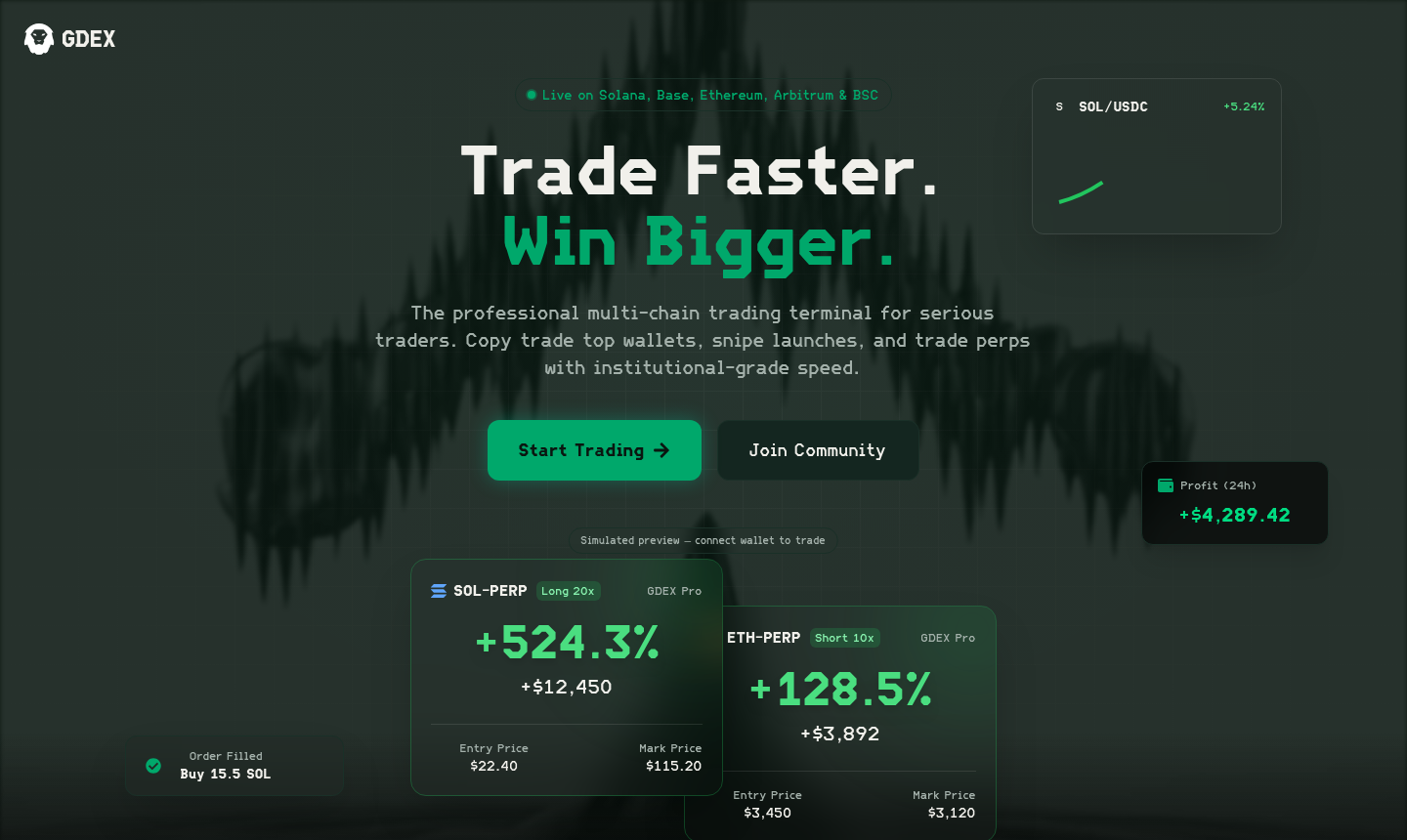
Navigate to gdex.pro in any browser — mobile Safari, Chrome, or Brave all work. No app download is required, and the terminal runs fully in-browser on both desktop and mobile.
Sign in with Google or Apple
Click Sign In and choose Google or Apple authentication. GDEX Pro uses Web3Auth threshold cryptography to generate your self-custody wallet from your login — no seed phrase is issued, but you can export your private key at any time from your account settings.
Switch the active chain to Base
Once inside the terminal, locate the chain selector (usually displayed as the current network name or icon near the top of the interface) and select Base from the list of 9 supported chains. The terminal will reload to show Base-native tokens, pools, and pricing.
Fund your Base wallet via Apple Pay
If your Base wallet balance is zero, use the built-in Apple Pay on-ramp to deposit fiat directly. The minimum deposit is $50, there is no KYC required for GDEX signup-to-trade, and the on-ramp fee is approximately 2-3% of the deposit amount. Funds arrive in your self-custody wallet as ETH on Base. No KYC is required for GDEX signup-to-trade. Third-party on-ramp providers may require identity verification and apply eligibility restrictions.
Search for the Base token you want to trade
Use the token search bar to find the Base chain token you want to buy or sell. You can search by name, ticker, or contract address. Always verify the contract address against a trusted source such as the project's official site or Basescan before trading an unfamiliar token.
Execute your swap
Enter the amount you want to swap, review the quoted output and the ~1% swap fee shown in the confirmation screen, and confirm the transaction. GDEX Pro routes the swap through aggregated liquidity on Base and the transaction settles on-chain to your self-custody wallet.
Fees for Trading Base Tokens on GDEX Pro
GDEX Pro charges approximately 1% on each swap. This fee is applied at the time of the trade and is visible in the confirmation screen before you commit. On top of the swap fee, Base chain transactions require a small amount of ETH for gas, though Base gas fees are typically very low compared to Ethereum mainnet.
If you are funding your wallet from fiat using Apple Pay, expect an additional on-ramp fee of approximately 2-3% on the deposited amount. For example, a $100 Apple Pay deposit would net roughly $97-$98 in ETH on Base after the on-ramp fee. There is no KYC requirement for GDEX signup-to-trade for the on-ramp, and the $50 minimum applies. No KYC is required for GDEX signup-to-trade. Third-party on-ramp providers may require identity verification and apply eligibility restrictions.
- Swap fee: ~1% per trade
- Apple Pay on-ramp fee: ~2-3%, $50 minimum, signup-to-trade without KYC No KYC is required for GDEX signup-to-trade. Third-party on-ramp providers may require identity verification and apply eligibility restrictions.
- Base chain gas fees: very low (fractions of a cent per transaction)
- No subscription or platform fee listed in GDEX facts
Risks You Should Know Before Trading Base Tokens
Base chain hosts a large number of new and experimental tokens, including memecoins with very low liquidity. Low-liquidity tokens are vulnerable to high slippage, rug pulls, and price manipulation. Always verify a token's contract address on Basescan and research the project before buying.
GDEX Pro is a self-custody terminal, which means no third party holds your funds — but it also means there is no customer support that can reverse a transaction or recover funds sent to the wrong address. Double-check every contract address and wallet address before confirming a swap. Crypto trading carries significant risk of loss, and past performance of any token is not a guarantee of future results.
- Verify contract addresses on Basescan before trading unknown tokens
- Self-custody means you are solely responsible for your wallet security
- Export and back up your private key from account settings as a precaution
- Do not trade more than you can afford to lose
Why GDEX Pro Works Well for Base Chain Trading
Compare each platform’s current custody, key-export and recovery documentation directly. The published wallet documentation describes user-controlled, exportable private keys. Agent execution is separately documented as using server-side managed wallets; review that model before enabling automation. Secure your sign-in account and any exported backup. Self-custody does not eliminate interface, account, smart-contract or market risk.
The Apple Pay on-ramp is a practical advantage for Base specifically. Because Base is an ETH Layer 2, you need ETH on Base to pay gas and to swap. The built-in on-ramp lets you go from zero to trading Base tokens in a single session without using a centralized exchange as an intermediary.
Other GDEX Pro Features Available on Base and Beyond
Beyond spot swaps, GDEX Pro offers perpetuals trading via HyperLiquid integration for traders who want leveraged exposure. The platform also includes AI copy-trading with up to 6 AI agent wallets you can configure, which can be useful for following automated strategies across supported chains.
30% of GDEX's net trading fee from direct referrals and 10% from their referrals, no cap. Earnings depend on referral activity and aren't guaranteed.
Frequently Asked Questions
Can I trade Base chain tokens on GDEX Pro without KYC?
Yes. GDEX Pro requires signup-to-trade without KYC to trade or to use the Apple Pay fiat on-ramp. You sign in with Google or Apple and can start swapping Base tokens immediately. No KYC is required for GDEX signup-to-trade. Third-party on-ramp providers may require identity verification and apply eligibility restrictions.
What is the fee to swap tokens on Base using GDEX Pro?
GDEX Pro charges approximately 1% per swap. If you fund your wallet via Apple Pay, there is an additional on-ramp fee of approximately 2-3% on the deposit amount, with a $50 minimum.
Does GDEX Pro support Base chain?
Yes. GDEX Pro supports the nine highlighted networks including Base, Solana, Ethereum, BNB, Arbitrum, Optimism, Sui, Sonic, and Berachain. You can switch between chains within the same self-custody wallet. Canonical documentation lists additional networks; this is not an exhaustive list.
Is GDEX Pro safe to use for Base token trading?
Wallet access uses user-controlled, exportable keys as described in the wallet documentation. Agent execution is separately documented as using server-side managed wallets. Check the custody model and permissions of the feature you are using before allocating funds.
Do I need to download an app to use GDEX Pro on Base?
No. GDEX Pro works entirely in-browser, including on mobile Safari. No app download is required.
What is the minimum amount I need to start trading Base tokens on GDEX Pro?
The Apple Pay fiat on-ramp has a $50 minimum deposit. Check current transaction limits and network or provider charges before proceeding.
How does GDEX Pro compare to BullX or Photon for Base chain trading?
Check each platform’s current documentation for supported features, fees and access requirements. This guide does not establish a comparative performance or security ranking.
Can I use GDEX Pro to trade Base tokens and Solana tokens from the same wallet?
Yes. GDEX Pro's self-custody wallet supports the nine highlighted networks, so you can switch between Base and Solana (or any other supported chain) within the same account without creating separate wallets. Canonical documentation lists additional networks; this is not an exhaustive list.
Bottom Line
Compare each platform’s current custody, key-export and recovery documentation directly. The published wallet documentation describes user-controlled, exportable private keys. Agent execution is separately documented as using server-side managed wallets; review that model before enabling automation. Secure your sign-in account and any exported backup. Self-custody does not eliminate interface, account, smart-contract or market risk.
Self-custody. $50 minimum. No KYC.