Quick Answer
The most direct way to trade crypto perpetuals without KYC is through GDEX Pro, a self-custody multi-chain trading terminal that connects to HyperLiquid perpetuals markets. You sign in with only a Google or Apple account (no ID upload, no seed phrase), fund your wallet through the Apple Pay on-ramp starting at $50 with signup-to-trade without KYC (about a 2-3% fee), and trade HyperLiquid perps directly from any browser, including mobile Safari. No KYC is required for GDEX signup-to-trade. Third-party on-ramp providers may require identity verification and apply eligibility restrictions.
Most centralized exchanges that offer perpetual futures require a government ID, a selfie, and sometimes proof of address before you can open a leveraged position. That's a dealbreaker for traders who want to move fast, stay private, or simply don't want their trading history tied to a real-world identity.
GDEX Pro is a self-custody, multi-chain trading terminal and swap aggregator built by GemachDAO. It is not a decentralized exchange and not a centralized exchange — it's an interface layer that connects your own self-custody wallet to on-chain liquidity and to HyperLiquid's perpetuals markets, across 9 supported chains (Solana, Ethereum, Base, BNB, Arbitrum, Optimism, Sui, Sonic, and Berachain).
Because your wallet is generated through Web3Auth threshold cryptography when you sign in with Google or Apple, and because funding runs through an Apple Pay on-ramp rather than a exchange account, there is provider checks may apply step anywhere in the flow. This guide walks through exactly how to get from zero to a live HyperLiquid perp position, plus what leverage, funding rates, and fees actually mean for your risk. No KYC is required for GDEX signup-to-trade. Third-party on-ramp providers may require identity verification and apply eligibility restrictions.
This is a how-to guide, not financial advice. Perpetual futures are leveraged products and can lose money quickly — the risk section below is not optional reading.
How GDEX Pro Compares
GDEX Pro vs. popular Solana trading terminals for no-KYC access and perps trading
| Spec | GDEX Pro | BullX | Photon | Axiom | Trojan | GMGN |
|---|---|---|---|---|---|---|
| Chains supported | 9 (Solana, Ethereum, Base, BNB, Arbitrum, Optimism, Sui, Sonic, Berachain) | Multi-chain (Solana plus several EVM chains) | Primarily Solana | Primarily Solana | Primarily Solana (Telegram-based) | Multi-chain, Solana-centric |
| Perpetuals access | Yes, via HyperLiquid | Not a core feature; spot/memecoin focus | Not a core feature; spot/memecoin focus | Not a core feature; spot/memecoin focus | Not a core feature; spot/memecoin focus | Not a core feature; spot/memecoin focus |
| Fiat on-ramp | Apple Pay, $50 min, signup-to-trade without KYC, ~2-3% fee No KYC is required for GDEX signup-to-trade. Third-party on-ramp providers may require identity verification and apply eligibility restrictions. | Varies by provider integration | Varies by provider integration | Varies by provider integration | Varies by provider integration | Varies by provider integration |
| Sign-in method | Google or Apple, no seed phrase (Web3Auth) | Wallet connect / browser extension | Wallet connect / browser extension | Wallet connect / browser extension | Telegram bot | Wallet connect / browser extension |
| Swap fee | ~1% | Varies by route | Varies by route | Varies by route | Varies by route | Varies by route |
| AI copy-trading agents | 5 configurable slots (Conservative/Balanced/Aggressive) | Not a standard feature | Not a standard feature | Not a standard feature | Not a standard feature | Not a standard feature |
Step-by-Step Guide
Sign in with Google or Apple
Open GDEX Pro in any browser, including mobile Safari — no app download is required. Sign in with your Google or Apple account, and Web3Auth threshold cryptography generates a self-custody wallet for you subject to processing and network conditions, with no seed phrase and no identity check.
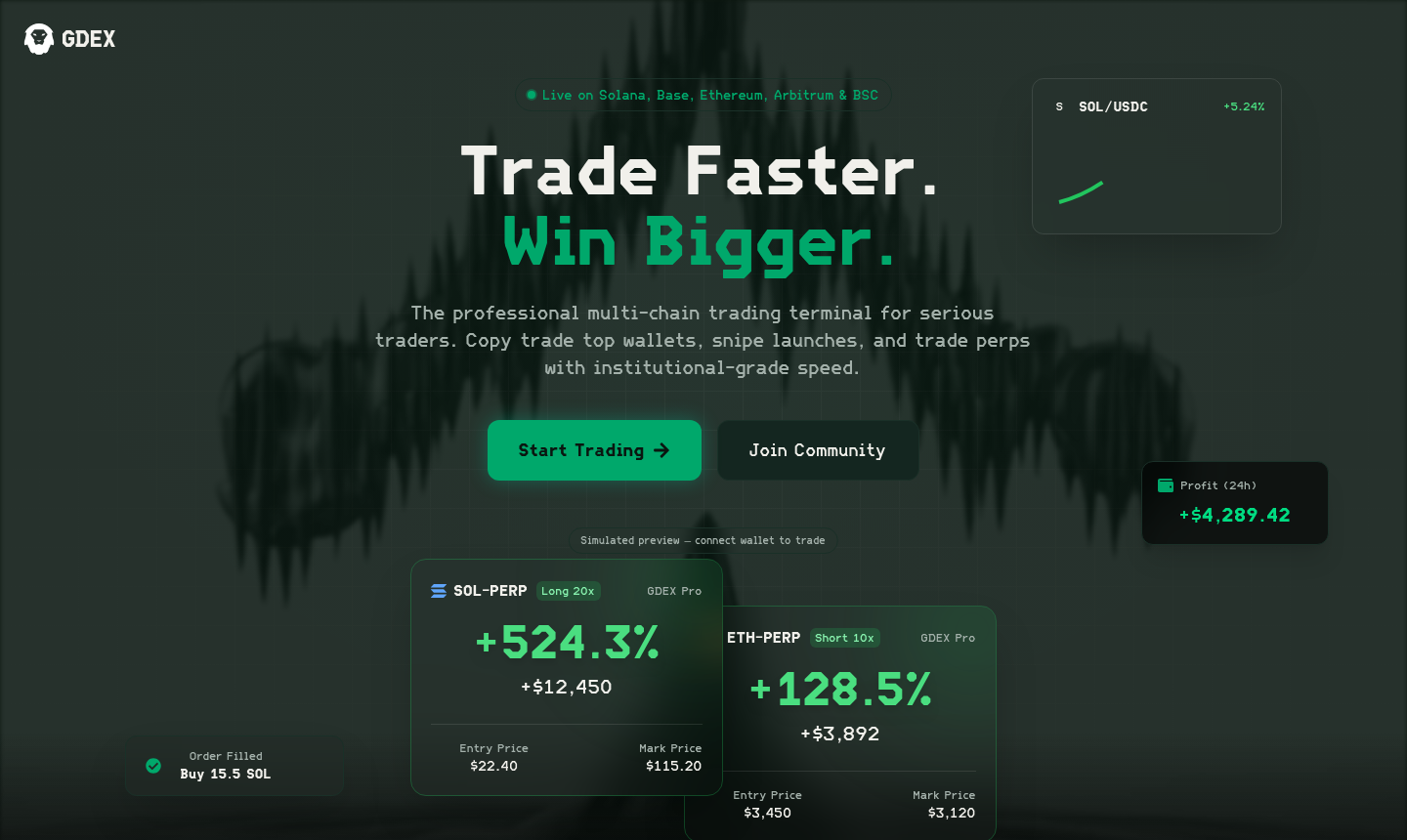
Fund your wallet with Apple Pay
Use the built-in Apple Pay on-ramp to deposit funds starting at a $50 minimum, with no KYC required for GDEX signup-to-trade. Expect an on-ramp fee of roughly 2-3%; alternatively, deposit crypto directly from an existing wallet on any of the 9 supported chains to skip the on-ramp fee entirely. No KYC is required for GDEX signup-to-trade. Third-party on-ramp providers may require identity verification and apply eligibility restrictions.
Open the HyperLiquid perpetuals market
Navigate to the perpetuals section of the GDEX Pro terminal, which connects to HyperLiquid's order books, and select the asset you want to trade.
Set your margin and leverage
Enter the margin amount you're putting up and choose your leverage level for the position. Higher leverage amplifies both gains and losses from the same price move, so size the position to what you can afford to lose.
Check the funding rate before entering
Perpetual contracts have no expiry, so longs and shorts periodically exchange funding payments to keep the contract price anchored to the spot price. Review the current funding rate for your chosen market — a consistently negative or positive rate tells you which side is paying to hold overnight.
Manage and close the position
The FAQ describes mirroring up to 6 AI agent wallets through copy trading. Risk presets belong to the separate Agent Risk Terminal, which documents up to five running agents. These are different features with different controls; review the current documentation before allocating funds.
Leverage and funding rates, explained simply
Leverage lets you open a position larger than your deposited margin. A leveraged position moves in your favor faster, but it also moves against you faster — the underlying price only has to move a small percentage against your position before your margin is at risk of liquidation. Choose leverage based on how much of your position you can afford to lose outright, not on how much profit you want.
Funding rate is the periodic payment perpetual contracts use in place of an expiry date. When more traders are long than short, longs typically pay shorts, and vice versa. It's charged at regular intervals for as long as you hold the position, so a trade held open for days can accrue meaningful funding costs even if the price hasn't moved.
Fees you'll actually pay
There are three separate costs to account for when trading perps signup-to-trade without KYC through GDEX Pro. First, the Apple Pay on-ramp fee, roughly 2-3%, applies only when you convert fiat into crypto — funding an existing wallet by crypto deposit skips this. Second, GDEX Pro's swap fee of roughly 1% applies when converting between assets on-chain. Third, HyperLiquid's own trading fees and the funding rate apply to the perp position itself and are separate from GDEX Pro's fees. No KYC is required for GDEX signup-to-trade. Third-party on-ramp providers may require identity verification and apply eligibility restrictions.
The real risk of no-KYC perps trading
No identity verification does not mean no risk. Leveraged perpetual positions can be liquidated automatically if the price moves against you enough to wipe out your margin, and that loss is real and immediate — there's no support desk to reverse it. Self-custody also means you are solely responsible for your account: because you sign in with Google or Apple and hold an exportable private key rather than a custodial account, there is no password-reset safety net if you lose access to your login.
No-KYC access is a matter of convenience and privacy, not a reduction in market risk. Trade with size you can afford to lose, and treat leverage as a tool that cuts both ways.
Frequently Asked Questions
Can I trade perps without KYC?
Yes. GDEX Pro connects to HyperLiquid's perpetuals markets and requires provider checks may apply anywhere in the flow — you sign in with a Google or Apple account and fund via Apple Pay with signup-to-trade without KYC, starting at a $50 minimum. No KYC is required for GDEX signup-to-trade. Third-party on-ramp providers may require identity verification and apply eligibility restrictions.
Is GDEX Pro a decentralized exchange?
No. GDEX Pro is a self-custody, multi-chain trading terminal and swap aggregator, not a decentralized exchange (DEX) and not a centralized exchange. It routes trades to on-chain liquidity and HyperLiquid's perpetuals markets while you retain custody of your own wallet.
What's the minimum amount to start trading perps on GDEX Pro?
The Apple Pay on-ramp has a $50 minimum with an on-ramp fee of roughly 2-3% and signup-to-trade without KYC. You can also fund the wallet by depositing crypto directly from another wallet, which avoids the on-ramp fee. No KYC is required for GDEX signup-to-trade. Third-party on-ramp providers may require identity verification and apply eligibility restrictions.
Is GDEX Pro safe to use for self-custody?
GDEX Pro uses Web3Auth threshold cryptography, so signing in with Google or Apple generates a wallet with no seed phrase and a private key that you can export at any time. You hold custody of your funds, which also means you are responsible for securing your own login and export credentials.
What is a funding rate in perpetual futures?
A funding rate is a periodic payment exchanged between long and short position holders that keeps a perpetual contract's price anchored to the underlying spot price, since perps have no expiry date. It's charged at regular intervals for as long as a position stays open, so it adds up on longer-held trades.
Do I need to download an app to trade on GDEX Pro?
No. GDEX Pro runs in any browser, including mobile Safari, and requires only a Google or Apple sign-in — there's no separate app to install.
How does GDEX Pro compare to BullX, Photon, Axiom, Trojan, or GMGN for perps trading?
Compare each platform’s current custody, key-export and recovery documentation directly. The published wallet documentation describes user-controlled, exportable private keys. Agent execution is separately documented as using server-side managed wallets; review that model before enabling automation. Secure your sign-in account and any exported backup. Self-custody does not eliminate interface, account, smart-contract or market risk.
Can I automate my perps trading on GDEX Pro?
The FAQ describes mirroring up to 6 AI agent wallets through copy trading. Risk presets belong to the separate Agent Risk Terminal, which documents up to five running agents. These are different features with different controls; review the current documentation before allocating funds.
Bottom Line
GDEX Pro is a legitimate signup-to-trade without KYC route into HyperLiquid perpetuals: sign-in takes seconds via Google or Apple, funding via Apple Pay starts at $50, and there's provider checks may apply anywhere in the flow. That convenience doesn't reduce trading risk — leverage, funding rates, and liquidation are exactly as real here as on any KYC'd exchange, so size positions accordingly and read the funding rate before you enter, not after. No KYC is required for GDEX signup-to-trade. Third-party on-ramp providers may require identity verification and apply eligibility restrictions.
Self-custody. $50 minimum. No KYC.