Quick Answer
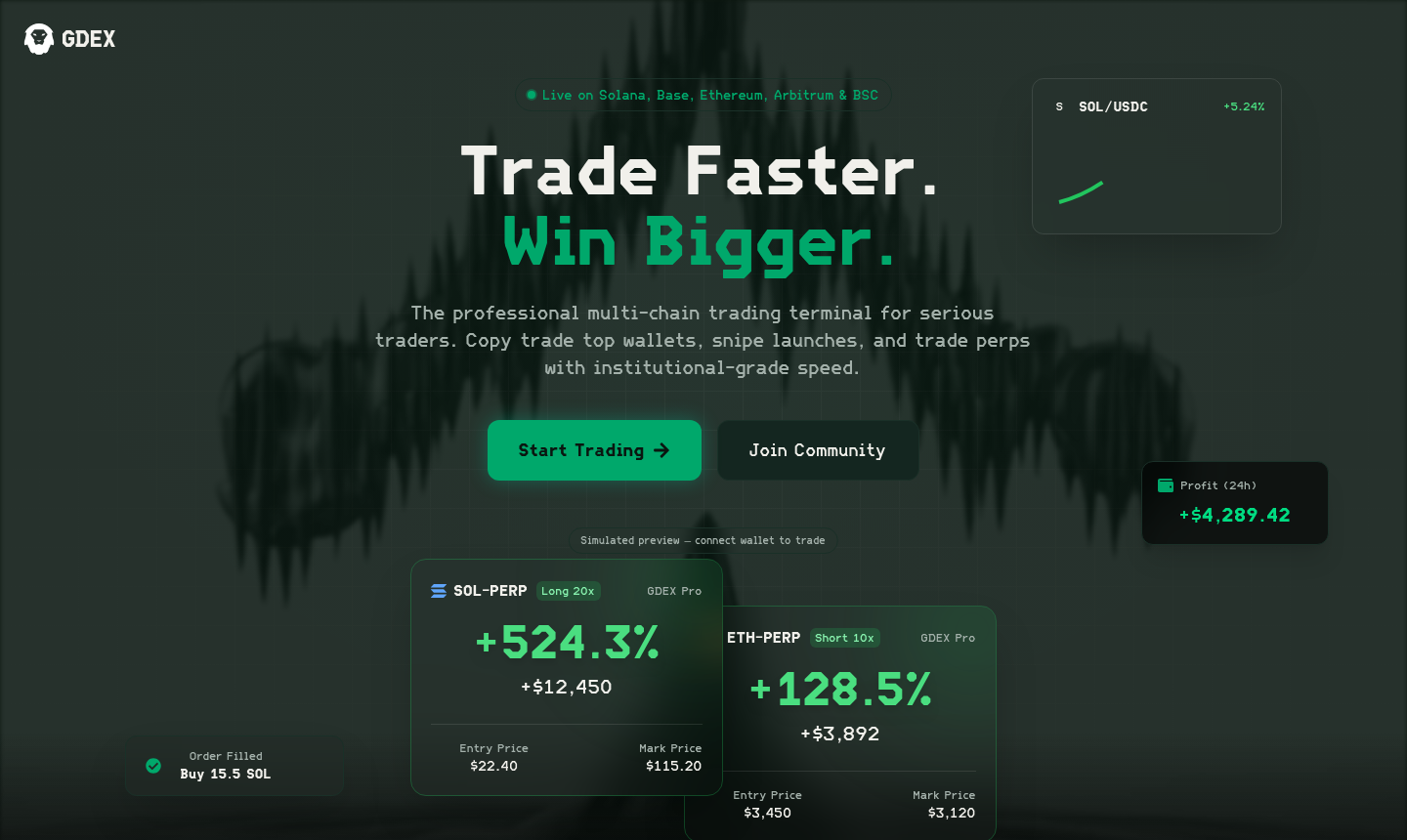
GDEX Pro is the way to trade HyperLiquid perps from your phone: it runs entirely in mobile Safari or any mobile browser, with no app to install. You sign in with Google or Apple, fund your account through the Apple Pay on-ramp starting at $50 with signup-to-trade without KYC (roughly a 2-3% on-ramp fee), and open HyperLiquid perpetual positions directly in the browser. Because it's self-custody, you hold your own keys the entire time. No KYC is required for GDEX signup-to-trade. Third-party on-ramp providers may require identity verification and apply eligibility restrictions.
Trading HyperLiquid perpetuals from a phone usually means fighting with a separate app, a browser extension wallet that doesn't work on mobile, or a desktop-only interface. GDEX Pro removes that friction by exposing HyperLiquid perps directly inside a mobile browser session, so the whole flow — sign-in, funding, and trading — happens on the phone you already have in your hand.
GDEX Pro (gdex.pro) is a self-custody, multi-chain trading terminal and swap aggregator built by GemachDAO. It is not a decentralized exchange and not a centralized exchange; it's a front-end that routes swaps across the nine highlighted networks (Solana, Ethereum, Base, BNB, Arbitrum, Optimism, Sui, Sonic, and Berachain) and exposes HyperLiquid's perpetual futures market, while your keys stay in your own self-custody wallet the entire time. Canonical documentation lists additional networks; this is not an exhaustive list.
The mobile angle comes from two design choices: sign-in uses Google or Apple accounts through Web3Auth threshold cryptography instead of a seed phrase, and funding runs through an Apple Pay on-ramp with a $50 minimum and signup-to-trade without KYC. Together, that means you can go from opening a browser tab to holding a leveraged HyperLiquid position without installing anything or copying down a recovery phrase. No KYC is required for GDEX signup-to-trade. Third-party on-ramp providers may require identity verification and apply eligibility restrictions.
None of that removes the real risk of leverage trading. This page covers the exact steps, the fees involved, and an honest look at liquidation risk before you fund an account.
How GDEX Pro Compares
GDEX Pro vs. other Solana-era trading terminals, mobile and perps access compared
| Spec | GDEX Pro | BullX | Photon | Axiom |
|---|---|---|---|---|
| Mobile access | Browser only (Safari/any), no app | Web app + Telegram bot | Web app | Web app |
| HyperLiquid perps | Yes, built in | No | No | No |
| Chains supported | 9 (Solana, Ethereum, Base, BNB, Arbitrum, Optimism, Sui, Sonic, Berachain) | Primarily Solana | Solana only | Primarily Solana |
| Fiat on-ramp | Apple Pay, $50 min, signup-to-trade without KYC, ~2-3% fee No KYC is required for GDEX signup-to-trade. Third-party on-ramp providers may require identity verification and apply eligibility restrictions. | varies | varies | varies |
| Swap fee | ~1% | varies | varies | varies |
| Custody model | Self-custody, Web3Auth, no seed phrase | Self-custody wallet | Self-custody wallet | Self-custody wallet |
| AI copy-trading agents | up to 6 AI agent wallets (Conservative/Balanced/Aggressive) | no | no | no |
Step-by-Step Guide
Sign in with Google or Apple
Open gdex.pro in your phone's browser and sign in with your Google or Apple account; a self-custody wallet is generated automatically via Web3Auth, with no seed phrase to write down.
Fund your account with Apple Pay
Use the Apple Pay on-ramp to deposit at least $50; expect an on-ramp fee of roughly 2-3%, and signup-to-trade without KYC is required to complete the deposit. No KYC is required for GDEX signup-to-trade. Third-party on-ramp providers may require identity verification and apply eligibility restrictions.
Open the HyperLiquid perps section
Navigate to the perpetuals area of the terminal, which is powered by HyperLiquid, directly from your phone's browser.
Pick a market, set size and leverage, confirm
Select the asset you want exposure to, set your position size and leverage, review the liquidation price shown, and confirm the trade.
Monitor margin and liquidation price
Keep an eye on your open position's margin and liquidation price from your phone, and close or adjust it before an adverse move triggers liquidation.
Fees You'll Actually Pay
Two fees matter for a mobile HyperLiquid perps trade on GDEX Pro. Getting fiat into the app costs roughly 2-3% through the Apple Pay on-ramp, with a $50 minimum deposit and signup-to-trade without KYC. Swapping between assets on the 9 supported chains carries a roughly 1% swap fee. No KYC is required for GDEX signup-to-trade. Third-party on-ramp providers may require identity verification and apply eligibility restrictions.
HyperLiquid itself applies its own protocol-level trading fees to perpetual positions, separate from GDEX Pro's on-ramp and swap fees. Factor both layers in before sizing a trade, especially for smaller positions where fixed and percentage costs eat a larger share of your margin.
- Apple Pay on-ramp: $50 minimum, signup-to-trade without KYC, ~2-3% fee No KYC is required for GDEX signup-to-trade. Third-party on-ramp providers may require identity verification and apply eligibility restrictions.
- Swap fee across supported chains: ~1%
- HyperLiquid protocol fees apply separately to perp trades
Leverage and Liquidation Risk
Perpetual futures use leverage, which multiplies both gains and losses. A relatively small adverse price move can push a leveraged position to its liquidation price, at which point your margin is lost. This is true on any HyperLiquid front end, including GDEX Pro.
Because GDEX Pro is self-custody, there is no exchange support desk to pause or reverse a liquidation. You are responsible for setting position size and leverage you can tolerate, and for watching your liquidation price as the market moves. Trading perps from a phone makes it easier to check a position, but it does not reduce the underlying leverage risk. Never risk funds you can't afford to lose, and treat leverage trading as inherently risky rather than an assured path to profit.
Self-Custody and Security
GDEX Pro uses Web3Auth threshold cryptography for sign-in: you authenticate with a Google or Apple account instead of managing a seed phrase, and the resulting private key is exportable if you want to move funds to another wallet.
The published wallet documentation describes user-controlled, exportable private keys. Agent execution is separately documented as using server-side managed wallets; review that model before enabling automation. Secure your sign-in account and any exported backup. Self-custody does not eliminate interface, account, smart-contract or market risk.
Automating Trades Instead of Managing Them Manually
The FAQ describes mirroring up to 6 AI agent wallets through copy trading. Risk presets belong to the separate Agent Risk Terminal, which documents up to five running agents. These are different features with different controls; review the current documentation before allocating funds.
30% of GDEX's net trading fee from direct referrals and 10% from their referrals, no cap. Earnings depend on referral activity and aren't guaranteed.
Frequently Asked Questions
Can I trade HyperLiquid perps on my phone without installing an app?
Yes. GDEX Pro runs in mobile Safari or any mobile browser, so there's no app to download; you sign in with Google or Apple and trade directly in the browser.
Is GDEX Pro safe to use?
Wallet access uses user-controlled, exportable keys as described in the wallet documentation. Agent execution is separately documented as using server-side managed wallets. Check the custody model and permissions of the feature you are using before allocating funds.
How do I fund a HyperLiquid perps trade on GDEX Pro?
Deposit through the Apple Pay on-ramp, which has a $50 minimum, no KYC requirement for GDEX signup-to-trade, and roughly a 2-3% fee; those funds then become available to open a HyperLiquid perpetual position. No KYC is required for GDEX signup-to-trade. Third-party on-ramp providers may require identity verification and apply eligibility restrictions.
Do I need to complete KYC to trade perps on GDEX Pro?
No KYC is required for GDEX signup-to-trade. Third-party on-ramp providers may require identity verification and apply eligibility restrictions. GDEX swaps cost approximately 1%. Third-party Apple Pay on-ramp fees are approximately 2–3%, with a $50 minimum stated in the FAQ. Provider documentation differs; check the live minimum. Review the exact quote before confirming; network fees and slippage are separate.
What's the risk of trading HyperLiquid perps with leverage?
Leverage magnifies both gains and losses, and an adverse price move can liquidate your position and wipe out your margin. There is no guarantee of profit, so only trade a size you can afford to lose.
Is GDEX Pro a decentralized exchange?
No. GDEX Pro is a self-custody, multi-chain trading terminal and swap aggregator that exposes HyperLiquid perps and swaps across the nine highlighted networks; it is neither a DEX nor a centralized exchange. Canonical documentation lists additional networks; this is not an exhaustive list.
What other chains does GDEX Pro support besides HyperLiquid perps?
GDEX Pro supports swaps across the nine highlighted networks: Solana, Ethereum, Base, BNB, Arbitrum, Optimism, Sui, Sonic, and Berachain, in addition to HyperLiquid perpetuals. Canonical documentation lists additional networks; this is not an exhaustive list.
How does GDEX Pro compare to BullX, Photon, or Axiom for mobile perps trading?
GDEX supports nine highlighted chains: Solana, Ethereum, Base, BNB, Arbitrum, Optimism, Sui, Sonic, Berachain. Verify each alternative’s current chain and feature coverage directly; no ranking is established here.
Bottom Line
GDEX Pro is a practical way to reach HyperLiquid perps from a phone without installing anything, thanks to a browser-based interface, Google/Apple sign-in, and Apple Pay funding from $50 with signup-to-trade without KYC. It's self-custody, so both security and liquidation risk sit entirely with you — there's no support desk to reverse a bad trade. For mobile perps access with a low entry point, it's a legitimate option; weigh its ~1% swap fee and ~2-3% on-ramp fee against your own trade size before funding an account. No KYC is required for GDEX signup-to-trade. Third-party on-ramp providers may require identity verification and apply eligibility restrictions.
Self-custody. $50 minimum. No KYC.